
The 10-minute audit: ten checks to run on a contractor's website from your phone
We scanned 165 independent plumbing, HVAC, electrical, roofing and appliance repair websites. Here are ten checks an agency can run on a prospect's site from a phone, in order, each with the share of sites that fail it.
- Only 17% of 165 independent home-service trade websites state a warranty with its terms, and 18% show any price (Clikiti Research, October 2026).
- 93% miss the 2.5 second load target on a phone, and 72% show no licence number as text.
- Each check below takes about a minute on a phone, and each failed check is a line item an agency can quote.
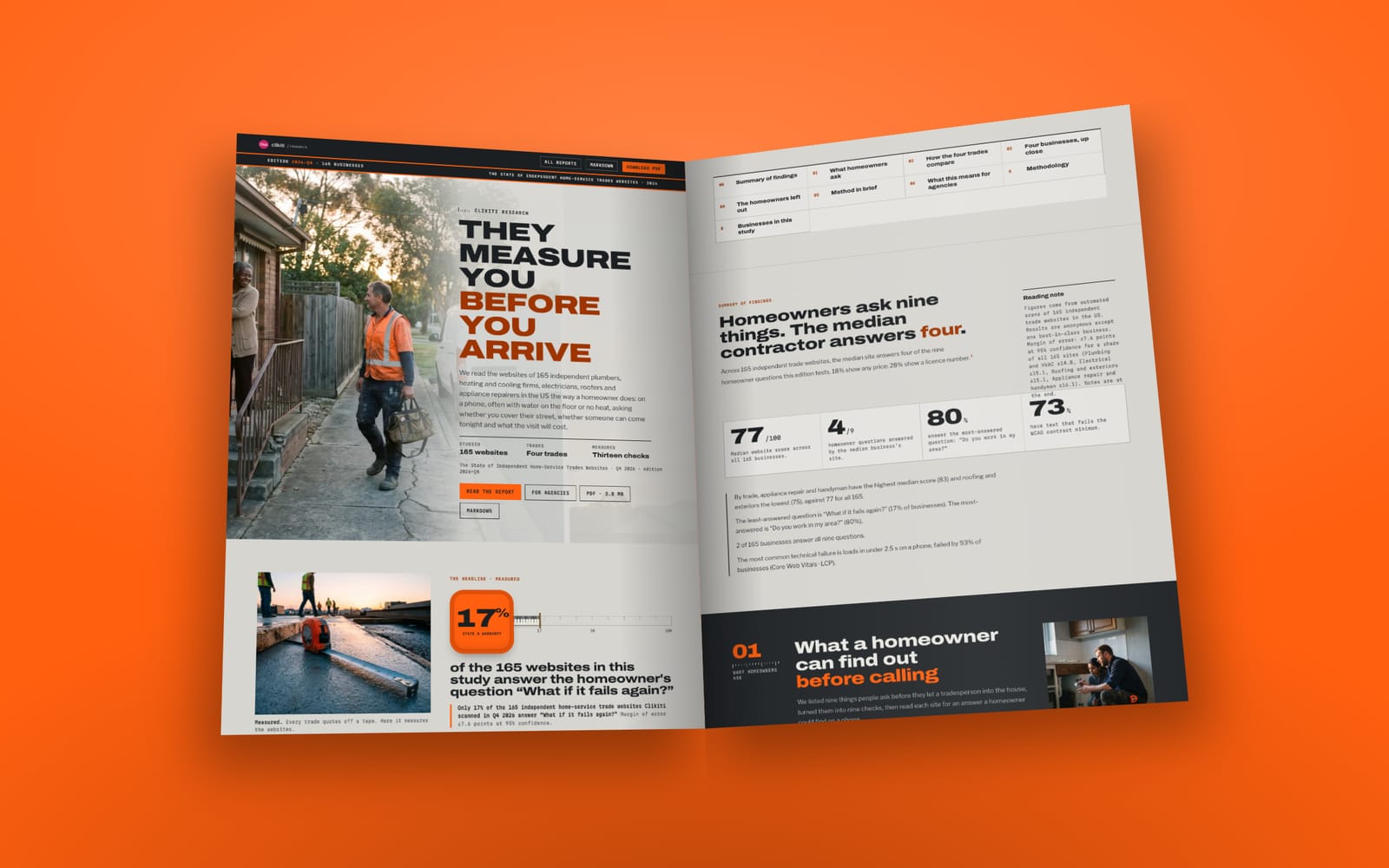
This is a site visit for a website. Ten checks, run on a phone, on one contractor's home page and the pages it links to. Each one matches a rule in The State of Independent Home-Service Trades Websites 2026, our scan of 165 independent plumbing and HVAC, electrical, roofing and appliance repair businesses in the US. Each one comes with the share of those sites that fail it, so you know before the call whether you are looking at the usual gap or a rare one.
The gap you will find most often: only 17% of the 165 sites state a warranty with its terms, in months or years, on parts or labour.
of the 165 websites we scanned answer “What if it fails again?” (warranty or guarantee stated with its terms).
What do you need before you start?#
A phone, the contractor's web address and a notes app. Use mobile data, not the office wifi, because that is how a homeowner sees the site. Write each check down as a pass or a fail, with a screenshot of the fail. Ten fails with screenshots is the first page of your proposal.
The scan read each site the same way: the home page plus up to nine pages it links to, such as services, service area, pricing, financing, warranty, about, reviews, booking and contact. Stay on those pages. If an answer is buried four clicks deep, a homeowner won't find it either.
The ten checks, in order#
1. Does the page show up fast?
Start a count when you tap the link. The study's line is the largest element on screen within 2.5 seconds on a phone. 93% of the sites miss it, and no electrician's site in the sample made it. You can't measure that by eye, so note whether the page is usable by the time you count three, and run PageSpeed Insights from your desk afterwards for the number.
2. Can you tap the phone number, and does the site say when someone answers?
Tap the number in the header. It should open the dialer. Then look for opening hours or "24/7" on the home page or the contact page. Both together pass. 36% of the sites fail, and 57% of the appliance repair and handyman sites do.
3. Does it say where they work?
Look for a service-area page, a list of towns or ZIP codes, or a line such as "serving" followed by a place. This is the best-answered question in the study: 80% pass, and 93% of roofers. If your prospect fails this one, they are in the bottom fifth.
4. Can someone come tonight?
Look for emergency, 24/7 or same-day service stated as something the business offers. A blog post warning about burst pipes doesn't count. 47% of the sites fail. Plumbing and HVAC firms do best at 68%, which still leaves a third of them silent on it.
5. Can you book without calling?
Find a button that books a visit or requests an estimate, or a scheduler you can open. A "call me back" form doesn't count. 40% of the sites have neither. Tap the button and go one screen further: if it lands on a form that works on a phone, that's a pass.
6. Is there a price anywhere?
Look for a dollar amount tied to something named: a service-call or diagnostic fee, an hourly rate, a tune-up, a job range. Coupons, "save $500" and monthly payment examples don't count. 82% of the sites show no price at all. Among electricians, 2% show one.
of the 165 websites we scanned answer “What will the visit cost?” (a price shown: a service call, a fee, a rate or a job).
7. Does it say what happens if the repair fails?
Look for a warranty or guarantee with its terms: a number of days, months or years, or lifetime, on parts or labour. "Satisfaction guaranteed" on its own doesn't pass. This is the least-answered question in the study, at 17%. Electricians are lowest at 10%.
8. Is there a licence number you could look up?
Look in the footer and on the about page for a state licence or registration number written out as text. "Licensed and insured" with no number fails, and so does a number that only appears inside a badge image. 72% of the sites fail. Among appliance repair and handyman sites, 3% pass.
9. Does it say the job can be paid monthly?
Look for financing: a statement that it's offered, or a named lender. 73% of the sites don't mention it. The split by trade is wide. 57% of plumbing and HVAC firms offer it on the site, against 10% of electricians, so check this one hardest on a prospect that does panel upgrades or roofs.
10. Do the neighbours vouch for them?
Look for reviews on the site itself: a review widget, review markup, or at least two quoted customer testimonials. A link out to Google doesn't pass. 49% of the sites fail. If the business has a strong Google rating and none of it shows on the site, write that down; it is the easiest fix on the list.
How do you read the score?#
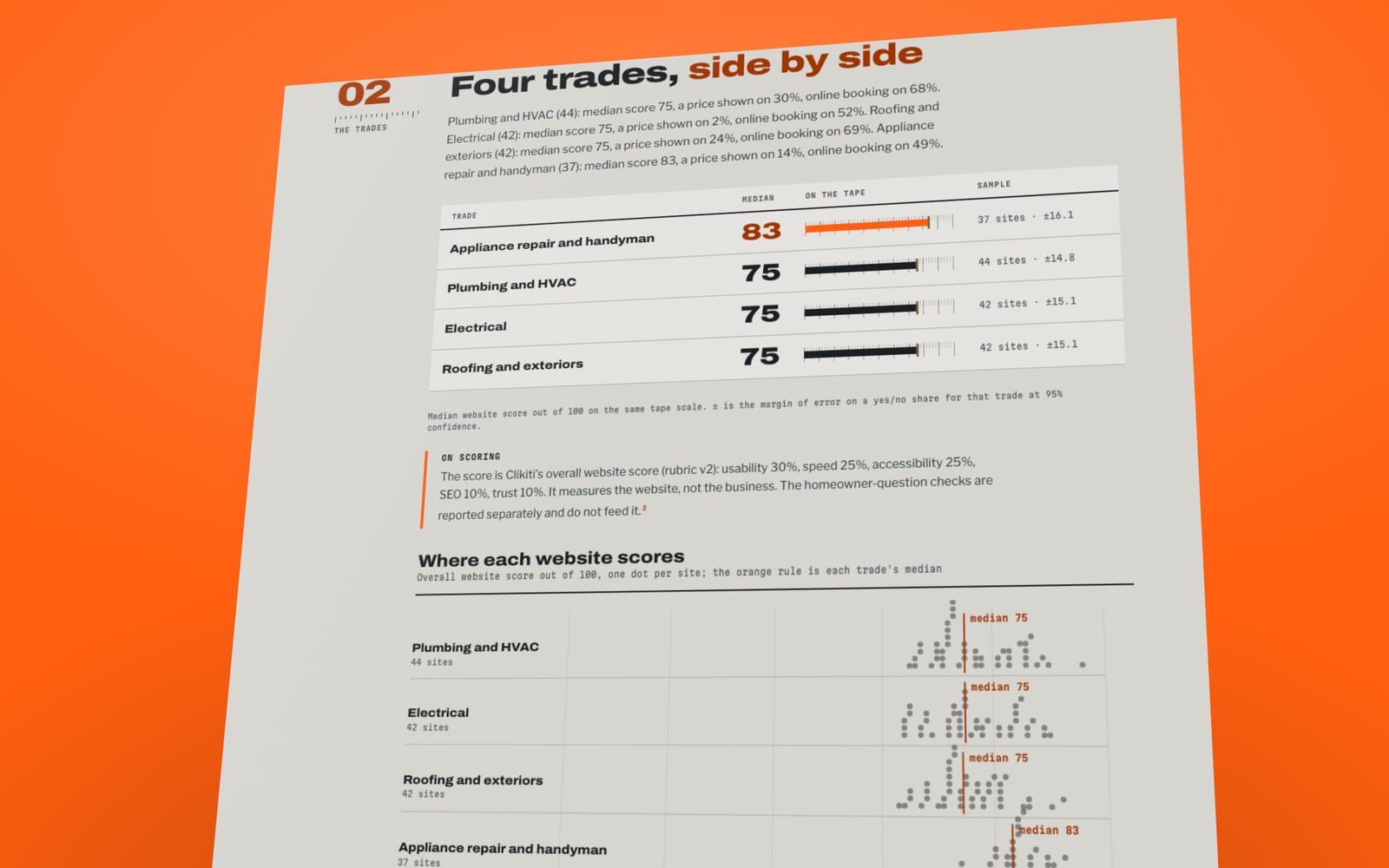
Add up the passes on the nine questions (checks 2 to 10). A typical site in the study answers four of them. Fewer than one in twenty answers all nine. So a prospect scoring three or four is normal, and the pitch isn't "your site is broken". It's "your site leaves out what homeowners ask, like most sites in your trade, and here are the ones that are cheap to add."
Share of sites that answer each question
165 websites · Independent home-service trades · Q4 2026
The best site in the study, 2nd Wind Heating & Air Conditioning in Columbia, South Carolina, answers eight of the nine. It states emergency service, lists its service area, shows a licence number, takes bookings online, offers financing, posts a tune-up price and shows reviews. It doesn't state a warranty with its terms. If the best site misses that one, your prospect probably does too.
Which fails do you lead with?#
Lead with the fails that are quick to fix and rare to pass. The report rates the warranty line, the licence number and reviews on the site as quick fixes, and all three are missing on most sites: 83%, 72% and 49%. Price and service area are content jobs, because the owner has to decide what to publish. Speed and booking are build work.
Turning the audit into a pitch
- Send the screenshots, not a score. Ten passes and fails, each with the share of contractors that fail it, read faster than a report card.
- Open with the warranty line. 83% of contractor sites don't state one with terms, and the owner already gives one on every job.
- Quote the quick fixes as one job. Warranty, licence number and on-site reviews take an afternoon and change three answers at once.
"Licensed and insured" is on every van. A number a homeowner can look up is not on your site.
For the page itself, block by block, see the spec for an emergency-first contractor home page. For how a different trade handles the price question, read the talk track for independent repair shops. All the numbers and the method are in the full report.
Keep reading
More on home services and the same problems in other industries
Before and after: the emergency-first home page for an independent contractor

72% of salon websites take bookings online. 42% say what happens if you cancel.

The inquiry email couples write because 91% of venue sites don't show open dates
How to cite
Clikiti Research (2026, October 15). The 10-minute audit: ten checks to run on a contractor's website from your phone. Clikiti. https://clikiti.com/research/posts/contractor-website-ten-minute-audit
Data and license
Every number comes from The State of Independent Home-Service Trades Websites 2026 (n = 165). Free to reuse under CC BY 4.0. Credit Clikiti with a link. Plain Markdown
About the images
People in the photographs on this page are AI-generated. No real person, school, firm or practice is shown. Last updated Oct 15, 2026.
One stat. One pitch. Every Tuesday.
A finding from our scans, what it means for the agencies selling to that industry, and the line to open a pitch with. Free.