Before and after: the emergency-first home page for an independent contractor
The typical contractor website answers four of the nine questions homeowners ask. This is the home page that answers all nine, block by block, with sample copy and the pitch for each block.
- Only 53% of 165 independent home-service trade websites say whether someone can come tonight, and 64% pair a tappable phone number with opening hours (Clikiti Research, October 2026).
- Fewer than one in five state a warranty with its terms (17%) or show any price (18%), and those two answers fit on the home page in four lines.
- The spec below is eight blocks. Most are copy changes on the template the contractor already has.
A homeowner who calls a plumber, an electrician or a roofer from a phone usually has a problem in front of them. The home page has a few seconds to say four things: we pick up, we come to you, we can come soon, and here is what it costs to get us out. This spec builds that home page block by block, in the order a homeowner reads it.
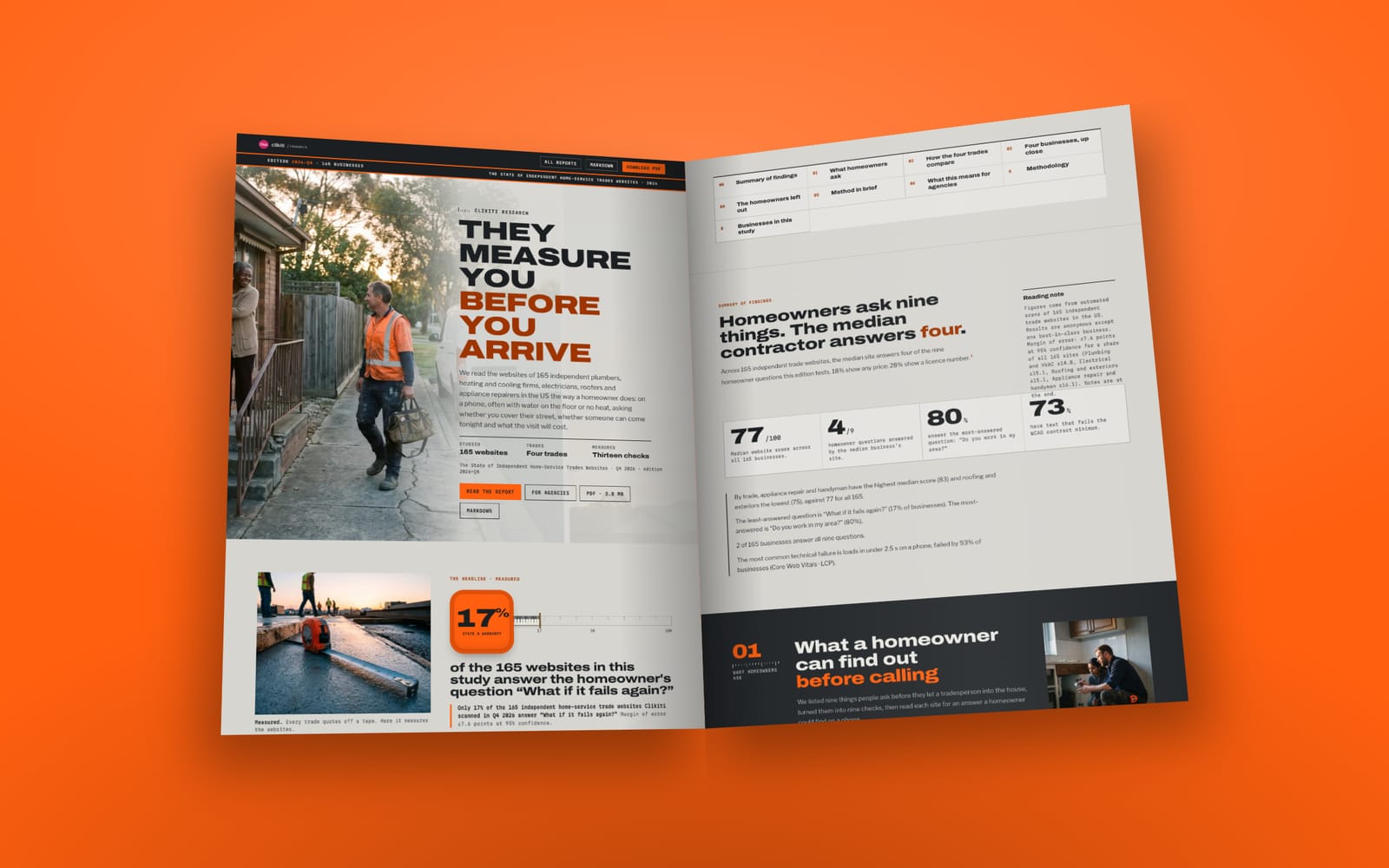
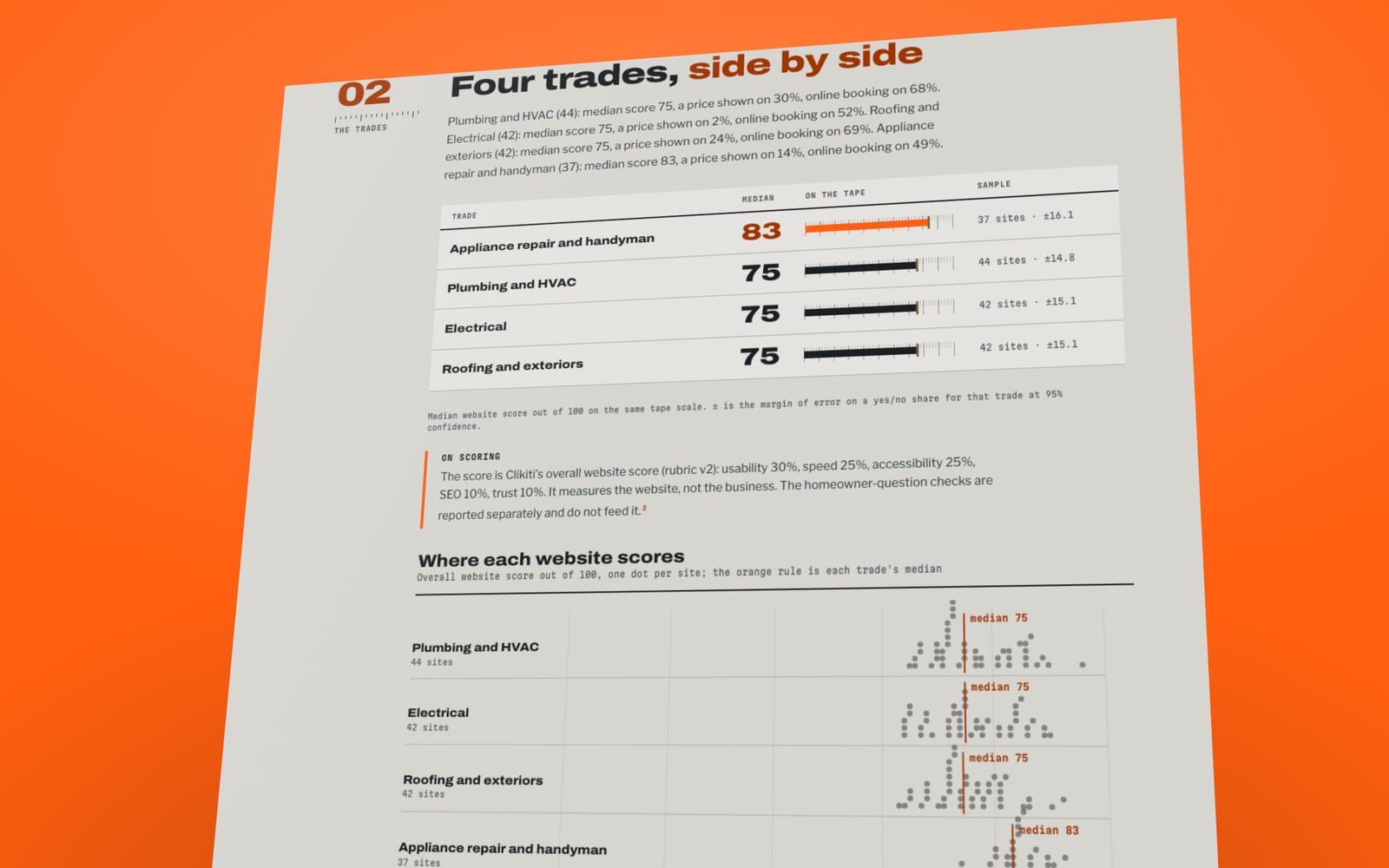
It is built on The State of Independent Home-Service Trades Websites 2026, our scan of 165 independent plumbing and HVAC, electrical, roofing and appliance repair websites in the US. Only 53% of them say whether someone can come tonight, and the typical site answers four of the nine homeowner questions the study tests.
of the 165 websites we scanned answer “Can someone come tonight?” (emergency, 24/7 or same-day service stated).
What does the before look like?#
The usual contractor home page, as the scan finds it, has a phone number in the header and a list of services. Below that sit a hero photo, a slogan, a row of brand logos and an about paragraph. The study's numbers for that page:
| Question | Sites that answer it |
|---|---|
| Do you work in my area? | 80% |
| How do I reach you, and when are you open? | 64% |
| Can I book without calling? | 60% |
| Can someone come tonight? | 53% |
| Do my neighbours vouch for you? | 52% |
| Are you licensed? | 28% |
| Can I spread the cost? | 27% |
| What will the visit cost? | 18% |
| What if it fails again? | 17% |
The after page answers all nine. Fewer than one in twenty sites in the study do that today.
The after, block by block#
1. The header: phone, hours, tonight
The phone number is a tap-to-call link, and beside it sits when someone answers. 36% of the sites miss one or the other, and 57% of appliance repair and handyman sites do.
Call now, we answer 24 hours a day. Emergency calls go straight to the technician on duty.
If the business doesn't take night calls, say so, and give the hours. A clear "we open at 7 am" passes the study's contact check. It also tells a homeowner to try someone else tonight and call back in the morning, which is better than ringing out.
2. The emergency line
One sentence, directly under the header, that says what kind of call the business takes after hours. 47% of the sites don't state emergency, 24/7 or same-day service anywhere. Plumbing and HVAC do best, and a third of them still say nothing.
Same-day service for leaks, no heat and no power. If you call before noon, we can usually be there today.
Only publish what the owner will stand behind. If there is no night service, "same-day service on weekdays" is a pass and an honest one.
3. The book button
A "Book service" or "Request an estimate" button in the header, through the scheduling software the business already uses. 40% of the sites have no way to book or ask for an estimate online. A call-back form doesn't count, in the study or for the homeowner.
4. The service area
A line under the hero naming the towns, linked to a page with the full list and the ZIP codes. 80% of the sites already pass this, so on most prospects the block is there and only needs moving up the page.
We work in the north county and the lake towns. See every town and ZIP code we cover on our service area page.
The towns come from the owner. Use the places they actually drive to, not a radius.
5. What the visit costs
This is the block most sites leave out: 82% show no price. The study passes a site when a dollar amount is tied to something named, such as a service call, a diagnostic fee, a rate or a job. A trade doesn't have to quote a job it hasn't seen. The service-call fee is the same for every house.
What it costs to get us out. One flat service-call fee covers the trip and the diagnosis. If you go ahead with the repair, the fee comes off the bill.
Under that line, publish the fee itself as a dollar amount, and if the owner agrees, a starting price for two or three common jobs. Electricians are where this block matters most: 2% of their sites show any price.
of the 165 websites we scanned answer “What will the visit cost?” (a price shown: a service call, a fee, a rate or a job).
6. The warranty, with its terms
The least-answered question in the study. 83% of the sites don't state a warranty with its terms. Most contractors give one on every job, so it is a matter of writing it down.
If it fails again, we come back. Our repairs carry a written warranty on parts and labour, and the terms are on every invoice.
Then add the actual terms in months or years, as the owner gives them. Only the stated terms pass the study's rule. "Satisfaction guaranteed" on its own doesn't.
7. The licence number
The state licence or registration number written as text in the footer, and again on the about page. 72% of the sites don't show one. Among appliance repair and handyman sites, 3% do.
8. Reviews and financing
Reviews from the business's own Google profile, shown on the page with a widget or review markup. 49% of the sites show none. For trades with big-ticket jobs, a financing line with the lender's name follows: 57% of plumbing and HVAC sites mention financing, against 10% of electricians.
New furnace, new roof, new panel? You can pay monthly. Ask about financing when you book your estimate.
How big is the job?#
The report rates the contact line, the emergency line, the warranty, the licence number and reviews as quick fixes. Price and service area are content jobs, because the owner has to decide what to publish. Booking is a build job, unless the business already has scheduling software with a booking link.
On a working site, that's a day of layout and a short list of facts from the owner: hours, night calls, towns, the service-call fee, warranty terms, the licence number and the lender. Send the list first. The page is quick once the answers come back.
Pitching the emergency-first home page
- Start with tonight. "A homeowner with water on the floor cannot tell from your site whether anyone will pick up." 47% of contractor sites don't say.
- Ask for the fee, not the quote. The service-call fee is the same for every house, and 82% of sites show no price at all.
- Write down the warranty they already give. 83% of sites don't state one with terms. It costs nothing and it is the rarest answer in the trade.
A homeowner with water on the floor cannot tell from your site whether anyone will pick up.
To check a prospect's current page against these blocks before the call, use the 10-minute audit. For how a dental practice builds the same kind of page around insurance, see the dental insurance build sheet. The full method is in the trades report.
Keep reading
More on home services and the same problems in other industries



How to cite
Clikiti Research (2026, October 15). Before and after: the emergency-first home page for an independent contractor. Clikiti. https://clikiti.com/research/posts/contractor-home-page-emergency-first-spec
Data and license
Every number comes from The State of Independent Home-Service Trades Websites 2026 (n = 165). Free to reuse under CC BY 4.0. Credit Clikiti with a link. Plain Markdown
About the images
People in the photographs on this page are AI-generated. No real person, school, firm or practice is shown. Last updated Oct 15, 2026.
One stat. One pitch. Every Tuesday.
A finding from our scans, what it means for the agencies selling to that industry, and the line to open a pitch with. Free.