

Clients shop for an agentbefore the storm
We read the websites of 170 independent insurance agencies in the US for nine questions clients ask before they call, among them which companies the agency quotes, who their agent would be, whether the agency is licensed in their state and how to file a claim.
0 websites
Four kinds of agency
Thirteen checks
The State of Independent Insurance Agency Websites · Q4 2026 · edition 2026-Q4
The headline
Most independent agency websites leave a client's question unanswered.

- Named insured
- 0 independent agencies
- Policy period
- Q4 2026
- Issued by
- Clikiti Research
0%
Summary of findings
Clients ask nine things. The median agency answers four.
Across 170 independent agency websites, the median site answers five of the nine client questions this edition tests. 40% name the insurance companies they represent; 39% say how to file a claim.1
What clients ask · 0 agencies
What a client can find out before calling
We turned nine questions people ask before they call an agency, or after a loss, into nine checks, then read each site for an answer a visitor could find on a phone.
Schedule of questions · share of all websites answering · orange = fewer than a quarter · tick = half
| Item | The client asks | Answered | Sites |
|---|
Figure 1. Share of sites that answer each question on the home page or a page it links to, read from the served HTML. Sorted from least to most answered.



The morning after
The claims question
of agency sites say how to file a claim, with a number or a link to do it.

Kinds of agency
Four kinds of agency, side by side
Personal lines (57): median score 78, carriers named on 53%, claims instructions on 56%. Commercial and business (43): median score 78, carriers named on 37%, claims instructions on 40%. Life, health and Medicare (41): median score 75, carriers named on 24%, claims instructions on 10%. Specialty: farm, marine and flood (29): median score 77, carriers named on 41%, claims instructions on 45%.
Where each website scores
Overall website score out of 100, one dot per site; the orange rule is each group's median
Figure 2. Overall website score out of 100, one dot per site. The orange rule marks each group's median.
Up close
Four agencies, up close
Four real sites from this edition, one strong, two in the middle and one weak. The photographs are illustrations; the agencies themselves stay anonymous. The number is the overall website score; each dot is one check, filled when the site passes it.
Ford Insurance Agency
Personal line, Traverse City, MI. It answers 8 of the 9 client questions this edition tests, passes every speed and accessibility check. Its overall website score is 82/100. Named as a positive example; every other site in this report is anonymous.
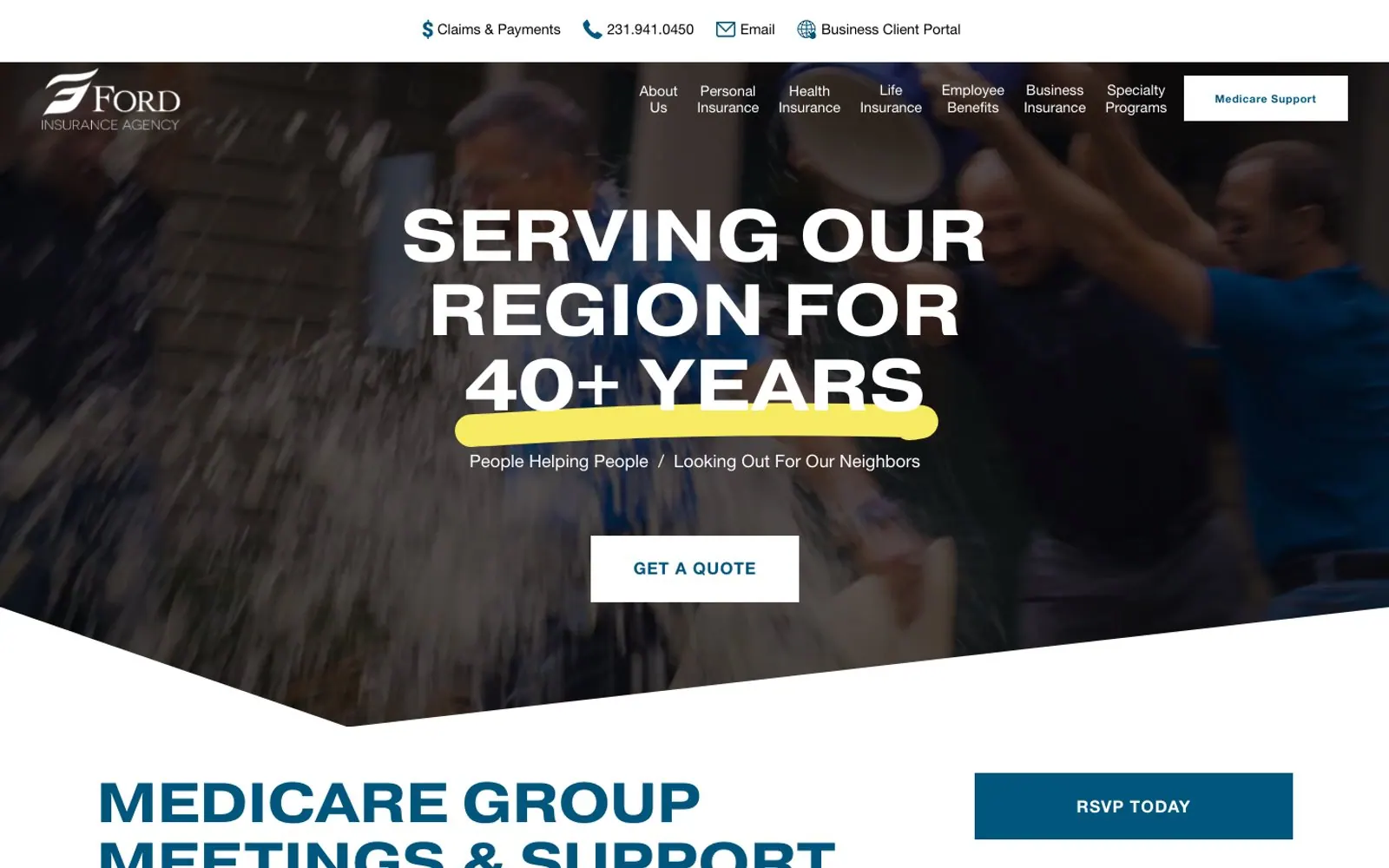
What it does well
- Tappable phone plus office hours
- Three or more lines of cover named
- Three or more insurance companies named in text
- A quote can be started online
- How to file a claim, with a number or link
- An agent named with their role
- Pay a bill or request a change online
- Reviews marked up, in a widget or quoted
- Real phone visitors see the main content in 1.8 s (Chrome UX Report, 75th percentile; good is 2.5 s or less)
- No text fails the WCAG 1.4.3 contrast minimum
- Every image has a text description (WCAG 1.1.1)
- Clikiti pillar scores of 90 or more: accessibility 96, SEO 90, trust 94
Where it could still improve
- Not found on the home page or the pages it links to: licence number, NPN or licensed states shown
Accessibility and speed
The clients left out
These checks measure whether a client using a screen reader, a keyboard or a slow phone connection can use the site at all.3
Table 1. Technical checks, share of the 170 sites that fail each one.
Method in brief
How the sites were read
Read
The home page and up to nine pages it links to (products, carriers, quote, claims, team, about, client service, reviews, contact), read as a server delivers them. The client questions are answered here, by fixed published rules (Appendix A4).
Measure
Google Lighthouse (PageSpeed Insights) in a phone and a desktop render, with Chrome UX Report field data where it exists: load time, contrast and image descriptions. Repeatable.
Review
An expert usability review of each home page against Nielsen's heuristics, used only in the usability part of the score. Every issue must name the heuristic, a severity and the element, or it is dropped.
Read the full methodology Sample, definitions, scoring, precision and limitations, in Appendix A.

For agencies and freelancers
What this means for agencies
what to fix first, and how to pitch it
For small agencies and freelancers who sell websites to independent insurance agencies. We scanned 170 of their websites: 1% score under 60 out of 100, and 79% leave at least three of the questions clients ask unanswered. Here is where the winnable work is, which problems to lead a pitch with, and how to show them without days of spec design.
Who is realistic to win
Life, health and Medicare are the most winnable: the lowest median score in this report (75 out of 100), and 0% of them score under 60. Their problems are visible, specific and fixable by a small team.
| Type | Sites | Median | Under 60 |
|---|---|---|---|
| Personal lines | 57 | 78 | 0% |
| Commercial and business | 43 | 78 | 2% |
| Life, health and Medicare | 41 | 75 | 0% |
| Specialty: farm, marine and flood | 29 | 77 | 0% |
Score out of 100. "Under 60" is the share of sites that miss most of what a client looks for.
5 problems to lead a pitch with
- 94%Loads in under 2.5 s on a phone Build
Resize and compress the hero image, defer chat and quote scripts, aim for under 2.5 s on a phone.
Your home page takes several seconds to appear on a phone.
- 79%Text contrast passes 4.5:1 Quick fix
Raise text contrast to at least 4.5:1 in the theme, including text over photos.
Parts of the site are hard to read, and it is a WCAG failure.
- 78%Are you licensed where I live? Quick fix
Put the agency licence number or NPN and the states it is licensed in on the footer and the about page.
A client cannot see from your site whether you are licensed in their state.
- 69%InsuranceAgency structured data Quick fix
Add InsuranceAgency structured data with the address, phone, hours and areas served.
Search engines and assistants have to guess what you are, where you are and when you are open.
- 64%Do other clients vouch for you? Quick fix
Show real client reviews through a review widget, marked up for search engines.
Your clients vouch for you elsewhere, and your site never shows it.
Share of sites with the problem. WCAG items are accessibility failures. Every check cites a standard in the method section.
How to show a prospect their problems, and a redesign
- 1Lead with their problem, not your services
Open with one question the site fails, for example loads in under 2.5 s on a phone (94% of sites in this report miss it), and show the exact page where the answer should be.
- 2Put a number on it
Compare their site with the sector: across 170 independent insurance agencies sites, the median scores 77 out of 100 and answers 5 of the 9 questions clients ask. A number travels further inside the client than an opinion.
- 3Show the fix without days of spec work
A rough redesign that answers those questions persuades better than a proposal, but it usually costs a designer a day or two per prospect. You can sketch it by hand, or use Clikiti: the scan is free and shows any site's problems in about a minute, and paid plans draft a redesign of the home page from the prospect's own brand, from about $2.33 per pitch.
Scan a prospect's site free No sign-up. You see what the prospect would see.
Show every agency what its clients see
Clikiti reads an agency's site the way a client does, states what it found, and generates the redesign you present before the first call.
See your market on ClikitiMethodology
How this study was designed, who was included, what was measured and how far the results can be relied on. It is written so that an agency can share it with a agency principal who wants to check the evidence behind a pitch.
A1. The research question
When someone shopping for cover, or a policyholder after a loss, looks an independent insurance agency up online, usually on a phone, can they find out how to reach it and when it is open, what it can insure, which insurance companies it represents, whether they can start a quote online, how to file a claim, who their agent would be and whether that agent is licensed, whether they can pay a bill or change a policy without calling, and whether other clients vouch for it?
Population. Independently owned US insurance agencies with one to three offices and their own website, representing more than one insurance company, in four groups: personal lines (home and auto), commercial and business, life, health and Medicare, and specialty (farm and crop, marine, flood and coastal). These are the insurance businesses a small or mid-size web agency can realistically win as clients.
A2. Who was studied
The sample was built from local search listings, city by city, then screened so that every site in it is one an independent agency could realistically win.
| Source | What it contributes | Sites |
|---|---|---|
| Local search, personal lines | Independent agencies selling home, auto, renters and umbrella cover, found through web search town by town and the city pages of a carrier's public agent locator (Progressive), which list independent agents with their own websites | 31 |
| Local search, commercial | Independent agencies selling business, contractor, workers' compensation and commercial auto cover, found through web search town by town and the same agent locator | 22 |
| Local search, life, health and Medicare | Independent life, health and Medicare brokers and agencies found through web search and a local-business directory's health insurance city pages (Expertise.com) | 44 |
| Local search, specialty | Independent agencies specialising in farm, ranch and crop, boat and marine, aviation, trucking, equine, or coastal wind and flood cover, found through web search and the same agent locator | 18 |
Included
- An independently owned agency with one to three offices and its own website (not a directory, marketplace or social profile)
- Represents more than one insurance company
- Based in the United States
- Home page responds and shows the agency it claims to be (each home page title was checked before scanning)
Excluded
- Captive agents of a single carrier, whose pages the carrier hosts or controls (for example State Farm, Allstate, Farmers, Nationwide, American Family, Country Financial and Farm Bureau agent pages)
- Insurance companies themselves
- National brokers and agencies owned by a broker roll-up (for example Marsh, Aon, Gallagher, Brown & Brown, HUB, Acrisure, Alera, AssuredPartners, World and Patriot Growth), identified from the site's own ownership statement; membership of an independent network such as SIAA or Iroquois does not exclude an agency
- Franchises (for example Goosehead, Brightway, Fiesta, Estrella) and any agency with four or more offices
- Quote comparison, lead-generation and directory sites
- Parked, placeholder, password-protected, hijacked or unreachable sites, and duplicates
| From list to sample | Sites |
|---|---|
| Candidates listed | 178 |
| Removed at screening: no response, refused automated visitors, or parked (0; candidates were checked against the research crawler while the list was built) | 0 |
| Removed at editorial review: an agency with an outside platform investor, an agency with four offices, a national aviation broker, and a domain that did not match the listed agency (4) | −4 |
| Cohort | 174 |
| Region (US Census) | Personal lines | Commercial and business | Life, health and Medicare | Specialty: farm, marine and flood | All |
|---|---|---|---|---|---|
| Northeast | 14 | 10 | 10 | 8 | 42 |
| Midwest | 14 | 10 | 10 | 6 | 40 |
| South | 14 | 11 | 11 | 9 | 45 |
| West | 15 | 12 | 10 | 6 | 43 |
| All regions | 57 | 43 | 41 | 29 | 170 |
A3. How the sites were read
Pages. The home page, then for each of nine topics (products, carriers, quote, claims, team, about, client service, reviews, contact) the best-matching link on the home page.
Speed and accessibility. Google PageSpeed Insights (Lighthouse) on a mid-range phone profile and on desktop, plus Chrome UX Report data from real visitors over the previous 28 days where Google publishes it for the site.
Crawler conduct. One request at a time to each site, at least 400 ms apart, at most ten pages per site; robots.txt is read and obeyed for every page requested; a site that refuses is left out and never retried. The crawler identifies itself as Mozilla/5.0 (compatible; ClikitiResearch/1.0; +https://clikiti.com).
A4. What was measured
9 questions people shopping for cover, and policyholders after a loss, ask before they call, answered from what each site publishes, and 4 technical checks against published standards. A check passes only when the rule below is met; anything the crawler cannot confirm counts as not answered.
| Question | Counts as answered when | Standard |
|---|---|---|
| How do I reach you, and when are you open?Tappable phone plus office hours | The home page has a tappable phone link, and the home, contact or about page states office hours (a day and a time range). | Clikiti client question 1 of 9 |
| What can you insure?Three or more lines of cover named | Three or more lines of cover are named on the home, products or about page (for example home, auto, umbrella, business, workers' compensation, life, Medicare Supplement, Medicare Advantage, flood, boat, farm). | Clikiti client question 2 of 9 |
| Which companies do you quote?Three or more insurance companies named in text | Three or more insurance companies the agency represents are named in the page text. Names that appear only inside logo images or their alt text do not count. | Clikiti client question 3 of 9 |
| Can I start a quote online?A quote can be started online | A link, button, form or embedded rater lets the visitor start a quote, request a quote or compare plans online. | Clikiti client question 4 of 9 |
| What do I do when I need to claim?How to file a claim, with a number or link | The site says how to file or report a claim and gives a way to do it: a phone number beside the instruction, a link to a carrier's claims page, or a claims page that lists numbers. | Clikiti client question 5 of 9 |
| Who would my agent be?An agent named with their role | At least one person at the agency is named with an insurance role (agent, producer, account manager, principal or a professional designation such as CIC or CISR). | Clikiti client question 6 of 9 |
| Are you licensed where I live?Licence number, NPN or licensed states shown | The site shows an insurance licence number, a National Producer Number, or the states in which the agency is licensed. | Clikiti client question 7 of 9 |
| Can I pay or change my policy without calling?Pay a bill or request a change online | A client can pay a bill, request a policy change, ID cards or a certificate of insurance online, through the agency's own client portal or links to the carriers' service pages. | Clikiti client question 8 of 9 |
| Do other clients vouch for you?Reviews marked up, in a widget or quoted | Client reviews are marked up for search engines (Review or AggregateRating structured data), shown through a review widget, or at least two client testimonials are quoted. | Clikiti client question 9 of 9 |
| Technical checks | ||
| Loads in under 2.5 s on a phoneLoads in under 2.5 s on a phone | Real visitors on phones see the main content within 2.5 seconds (Chrome UX Report, 75th percentile). Where Google publishes no visitor data, the phone lab test is used. | Core Web Vitals · LCP |
| Text contrast passes 4.5:1Text contrast passes 4.5:1 | No text on the home page fails the WCAG 1.4.3 minimum contrast of 4.5:1, in either the phone or desktop test. | WCAG 1.4.3 |
| Images have text descriptionsImages have text descriptions | Every meaningful image on the home page has a text description (WCAG 1.1.1). | WCAG 1.1.1 |
| InsuranceAgency structured dataInsuranceAgency structured data | The site describes the agency to search engines with InsuranceAgency structured data. | Schema.org · InsuranceAgency |
A5. The website score
Each site's overall score (0 to 100) is Clikiti's website score, rubric 2.0.0. It measures the website, not the agency, and the client questions above do not feed it. It is a weighted mean of five pillars:
| Pillar | Weight | Based on |
|---|---|---|
| Usability | 30% | Checks of the home page for broken links and images, and an expert review of the page as rendered on a phone and on a desktop screen, against Jakob Nielsen's ten usability heuristics. Each issue must name the heuristic, a severity on the Nielsen Norman Group scale and the exact element or wording; issues without all three are discarded, and two independent passes must agree. |
| Speed | 25% | Google Lighthouse on a mid-range phone (60%) and on desktop (20%), and real-visitor Core Web Vitals from the Chrome UX Report (20%) where available. |
| Accessibility | 25% | Google Lighthouse accessibility audits (70%) and Clikiti's own WCAG checks of the served page (30%). |
| Search | 10% | Google Lighthouse SEO audits (60%) and Clikiti's own search checks of the served page (40%). |
| Trust | 10% | Google Lighthouse best-practice audits (40%) and security header checks (60%). |
Within a pillar, each issue costs points by severity (critical, high, medium, low) and by how many times it occurs; issues based on judgement count at 70% of measured ones, and duplicates of the same root cause count once. On the four agency profiles, the number out of 100 is this overall score, and each dot is one check in its group: filled when the site passes it, hollow when it does not.
A6. Precision
With 170 sites, a share reported for the whole sample is precise to within ±7.5 percentage points at 95% confidence (worst case, a 50% share; 1.96 × √(0.25/n)). By type: personal lines ±13 (n = 57); commercial and business ±14.9 (n = 43); life, health and medicare ±15.3 (n = 41); specialty: farm, marine and flood ±18.2 (n = 29). Differences between types smaller than these margins should be read as similar. Percentages are rounded to whole numbers; medians are the middle value of the sites in a group.
A7. Quality control
- Every home page in the cohort was fetched and its title checked against the listed agency before scanning, and every home page was checked for unrelated spam content (gambling, pharmacy, adult, crypto)
- Ownership statements in site footers were checked for broker roll-ups before scanning
- Detection rules were checked against the evidence they record for a sample of agencies in every group, and revised before the final run
- The agency-website vendor behind each site, where its markup names one, is recorded so that template boilerplate can be told apart from an agency's own answers
- Every published figure is recomputed from the data at build time, and a statement in the text that the data does not support stops the build
- Results are published only after automated checks for missing data, anonymity, accessibility of the report itself and the margin of error statement pass
A8. Limitations
- A point-in-time snapshot: sites change, and a site may have improved or declined since it was read.
- Only public pages were read: the home page and pages it links to. Quote forms were not submitted, client portals were not logged into and comparative raters were not run.
- Answers are read from the page as a server delivers it. Content that only appears after scripts run in the browser (some quote widgets, review widgets and carrier lists) is not seen, which the study counts as a gap a search engine or a slow phone would also meet.
- Many agency sites are built on a small number of agency-website platforms that supply standard pages; an answer that comes from such a template counts the same as one the agency wrote.
- The study reports what a website shows. It does not judge any agency's advice, any policy's cover or any premium, or compliance with any state insurance licensing or advertising rule.
- Automated accessibility tests find only part of what WCAG covers; keyboard and screen-reader use need a manual audit.
- The sample is a structured list of real, independent agencies, not a random draw. Margins of error are given as a guide to precision, not as a guarantee that the results hold for every agency in the country.
A9. Data, licence and corrections
The aggregate results are published as CSV and JSON beside this report under the Creative Commons Attribution 4.0 licence: you may reuse, adapt and share them, including in client proposals, with a credit to Clikiti and a link. No per-site results are published. Corrections and removal requests are reviewed and answered personally; see the end of this report.
Agencies in this study
The 170 websites in this edition, by type. This list says who was scanned and nothing more: results in this report are shown only in aggregate or anonymously.
Personal lines (57)
- A&P Insurance AgencyWorcester, MA
- Affiliated Brokers InsuranceKearney, NE
- Alliance Insurance AgencyMankato, MN
- Aloha Insurance ServicesKailua-Kona, HI
- Amsink Insurance AgencyHolland, MI
- Bagnall Shaw InsuranceLancaster, PA
- Bailey Place InsuranceIthaca, NY
- Benson Thomson AgencyDover, NJ
- Bilodeau Insurance AgencyLewiston, ME
- Blake Insurance AgencyBrainerd, MN
- Brooker Insurance AgencyValdosta, GA
- Byers Insurance GroupBowling Green, KY
- Cache Valley InsuranceLogan, UT
- Central Insurance AssociatesOssipee, NH
- Chadwick InsuranceWilmington, NC
- DJ Kauffman AgencyHutchinson, KS
- Donovan Insurance AgencyMinot, ND
- Fallon AgencyWesterly, RI
- Ford Insurance AgencyTraverse City, MI
- Fortner Insurance AgencyPeoria, IL
- Gary Maxwell Insurance AgencyCookeville, TN
- Gibb AgencyTyler, TX
- Gordon Wood InsuranceRoseburg, OR
- Grimes Insurance AgencyLubbock, TX
- Hassett InsurancePhoenix, AZ
- Haymond InsuranceSearcy, AR
- Hibbs Insurance AgencyPaducah, KY
- Holder Insurance AgencyOcala, FL
- Hosler-Corbin Insurance AgencyFindlay, OH
- Insurance Solutions by Laramie Investment CompanyLaramie, WY
- Insure It AllIdaho Falls, ID
- Juul Insurance AgencyNorth Bend, OR
- Kinghorn Insurance of BeaufortBeaufort, SC
- Martin-Trudeau InsuranceMitchell, SD
- North Town InsuranceSpokane, WA
- Oaks Independent Insurance SolutionsPaso Robles, CA
- Oliver Insurance AgencyEau Claire, WI
- Palmer & AssociatesGlastonbury, CT
- PF Northeast BrokerageHopewell Junction, NY
- Robert E. Maloney Insurance AgencyNorwood, MA
- Robert Lloyd Coutts & SonsMorristown, NJ
- Rock Creek InsuranceChattanooga, TN
- Skies West Insurance AgencyFort Collins, CO
- Slingluff United InsuranceDothan, AL
- Sterling Peaks InsuranceGrand Junction, CO
- Summit Insurance AgencyMissoula, MT
- Terrebonne Insurance AgencyHouma, LA
- The Bon AgencyCasper, WY
- Thousand Islands AgencyClayton, NY
- Toth Insurance AgencyTorrington, CT
- Town & Country Insurance AgencySedalia, MO
- Traxler Insurance AgencyFort Wayne, IN
- Van Engelenhoven AgencyOrange City, IA
- W.A. Mitchell AgencyMiles City, MT
- Wickline Insurance AgencyBeckley, WV
- Wyman AgencyAscutney, VT
- Yakima Valley InsuranceYakima, WA
Commercial and business (43)
- 643 InsuranceChandler, AZ
- Barney Insurance AgencyCanaan, NH
- Broward Hall Insurance AgencyPanama City, FL
- Business Insurance AssociatesAnchorage, AK
- CCIS Bonding & Insurance ServicesFresno, CA
- Combs InsurancePalmer, AK
- Crane AgencyChesterfield, MO
- David Chapman AgencyLansing, MI
- Ed Smith Insurance AgencyFlorence, SC
- Fee Insurance GroupHutchinson, KS
- First Choice Insurance AgencyAmityville, NY
- Hammond Insurance ServicesStaunton, VA
- Henkes Welsh AgencyReno, NV
- Higgins & Rutledge InsuranceTwin Falls, ID
- Homer Yost Insurance AgencyWooster, OH
- Insurance AssociatesNorfolk, NE
- Insurance Center of HarrisonburgHarrisonburg, VA
- Insurance Specialists of OklahomaStillwater, OK
- ISE Insurance ServicesTracy, CA
- Jim Wilson Insurance AgencyJackson, TN
- JM Insurance GroupBillings, MT
- Julius A. Rose, Inc.Bayonne, NJ
- Keetch InsuranceCorpus Christi, TX
- Lathrop InsuranceWesterly, RI
- Lewis Mohr Insurance AgencyBaton Rouge, LA
- Libke InsuranceWenatchee, WA
- McIlrath Insurance AgencyPittsburgh, PA
- Mel Foster InsuranceDavenport, IA
- Messer-BowersEnid, OK
- Newbrook Insurance AgencyPort Jefferson Station, NY
- Nicholas A. Consoles Insurance AgencyPeabody, MA
- Ochsner InsuranceReno, NV
- Powers Insurance & Risk ManagementSt. Louis, MO
- Richard Squeri Insurance AgencyBranford, CT
- RME InsuranceLafayette, IN
- Robinson & MayValdosta, GA
- Slawsby Insurance AgencyMerrimack, NH
- Spectrum Insurance GroupEau Claire, WI
- T.S. Peck InsuranceSouth Burlington, VT
- The Adams AgencyMesa, AZ
- The Brunt GroupLafayette, LA
- Weedin AgencyLoveland, CO
- Weis InsuranceEffingham, IL
Life, health and Medicare (41)
- Affordable Life & HealthTulsa, OK
- AIS Medicare and MoreColorado Springs, CO
- Aponi InsuranceColorado Springs, CO
- Asheville Senior BenefitsAsheville, NC
- Bolte Insurance AgencyPort Clinton, OH
- Burkes Group InsuranceJackson, MS
- Butterfield AgencySpokane, WA
- Cornerstone Insurance AgencyLouisville, KY
- Cosmo Insurance AgencyLakewood, NJ
- Derby Insurance SolutionsTulsa, OK
- DeverCare Insurance GroupAkron, PA
- Fredriksen Health InsuranceBoise, ID
- Gina Ruth InsuranceScottsdale, AZ
- Great Plains MedicareSioux Falls, SD
- Greenway & AssociatesPueblo, CO
- Halsi Insurance ServicesTucson, AZ
- Health Benefits of BoiseMeridian, ID
- Health Insurance AssociatesNorth Haven, CT
- Health Insurance SolutionsCharleston, SC
- Hitcho InsuranceAllentown, PA
- ICT Health InsuranceWichita, KS
- Karen Cooper AgencySanta Fe, NM
- Louisiana Insurance CenterBaton Rouge, LA
- Maine Insurance Benefits GroupWindham, ME
- Medicare Insurance OptionsBelleville, IL
- Midwest Division Insurance AgencySioux Falls, SD
- My Medicare QuotesDoylestown, PA
- My Policy Shop Insurance AgencyGrand Rapids, MI
- National Care Insurance AgencyKnoxville, TN
- Newbury FinancialEvansville, IN
- Paul B InsuranceGreenlawn, NY
- Prairie Grove InsuranceMadison, WI
- Senior Services of North AmericaUniondale, NY
- Skyview Insurance ServicesCorpus Christi, TX
- Smiley Face InsuranceNewburgh, IN
- T4 Medicare InsuranceSpokane, WA
- Texas Health Insurance GroupCorpus Christi, TX
- The Medicare Help DeskTallahassee, FL
- Vermont Medicare PlanningSt. Albans, VT
- Voyage BenefitsGrand Rapids, MI
- Young's Insurance ServicesCollegeville, PA
Specialty: farm, marine and flood (29)
- Ag Specialist Insurance ServicesHereford, TX
- Agri Insurance, Inc.Beach, ND
- Aircraft & Marine Insurance AgencyVictoria, MN
- Allied Ranchers InsuranceNorfolk, NE
- Blue Bridle InsurancePittstown, NJ
- Casey Insurance CompaniesPlantation, FL
- Conquest Insurance AgencyBlackfoot, ID
- Crop Insurance SolutionsDumas, TX
- Eklund InsuranceGoodland, KS
- Garrison AgencyGuymon, OK
- Golden Plains Insurance AgencyLamar, CO
- Gulf Shores Insurance AgencyGulf Shores, AL
- Heritage Marine InsuranceMystic, CT
- Keller-Brown Insurance ServicesShrewsbury, PA
- Kelly Insurance GroupPittsburgh, PA
- Marvin Johnson & AssociatesColumbus, IN
- McMahon Insurance AgencyOcean City, NJ
- Mid-Montana InsuranceHarlowton, MT
- Midwest AgriCreditDanville, IL
- NC Coastal InsuranceWilmington, NC
- Robert O. Mable AgencyDelhi, NY
- Sonnenberg AgencySterling, CO
- Southernmost InsuranceKey West, FL
- Texas Coast Insurance AgencyRockport, TX
- The Hess AgencyMount Joy, PA
- The Insurance Center (CT Boat Insurance)Bethel, CT
- United Insurance and RealtyGlasgow, MT
- Weatherly Insurance AgencyKill Devil Hills, NC
- Wheatland Insurance CenterPendleton, OR
About this study
This report is based on automated scans of publicly available home pages, and pages they link to, run on 2026-10-15. Its findings are a point-in-time technical snapshot of each website. They are not a judgement of any agency's advice, any policy's cover or anyone's premiums, and automated checks may contain errors. This report is not insurance advice and not a judgement of any agency, carrier, policy or premium, and it does not assess compliance with any state insurance licensing or advertising rule. Clikiti is not affiliated with, and does not endorse, any agency listed here; trademarks belong to their owners. The report is provided “as is” under CC BY 4.0, without warranty of any kind. Every person in this report's photographs is AI-generated; none is a real person. The one agency screenshot is the featured agency's own home page, shown unaltered.
Remove my agency from this study
We review every request and reply when it's done; removed agencies are excluded from future editions.