
The agent page, measured: a spec for the 80% of sites with no licence number
80% of the 133 independent real estate websites we scanned show no licence number, and no solo agent or team site states a commission. This is one agent page, drawn to a schedule: what goes where, how big, and which client question each part answers.
- Only 20% of 133 independent real estate websites show a real estate licence number (Clikiti Research, October 2026).
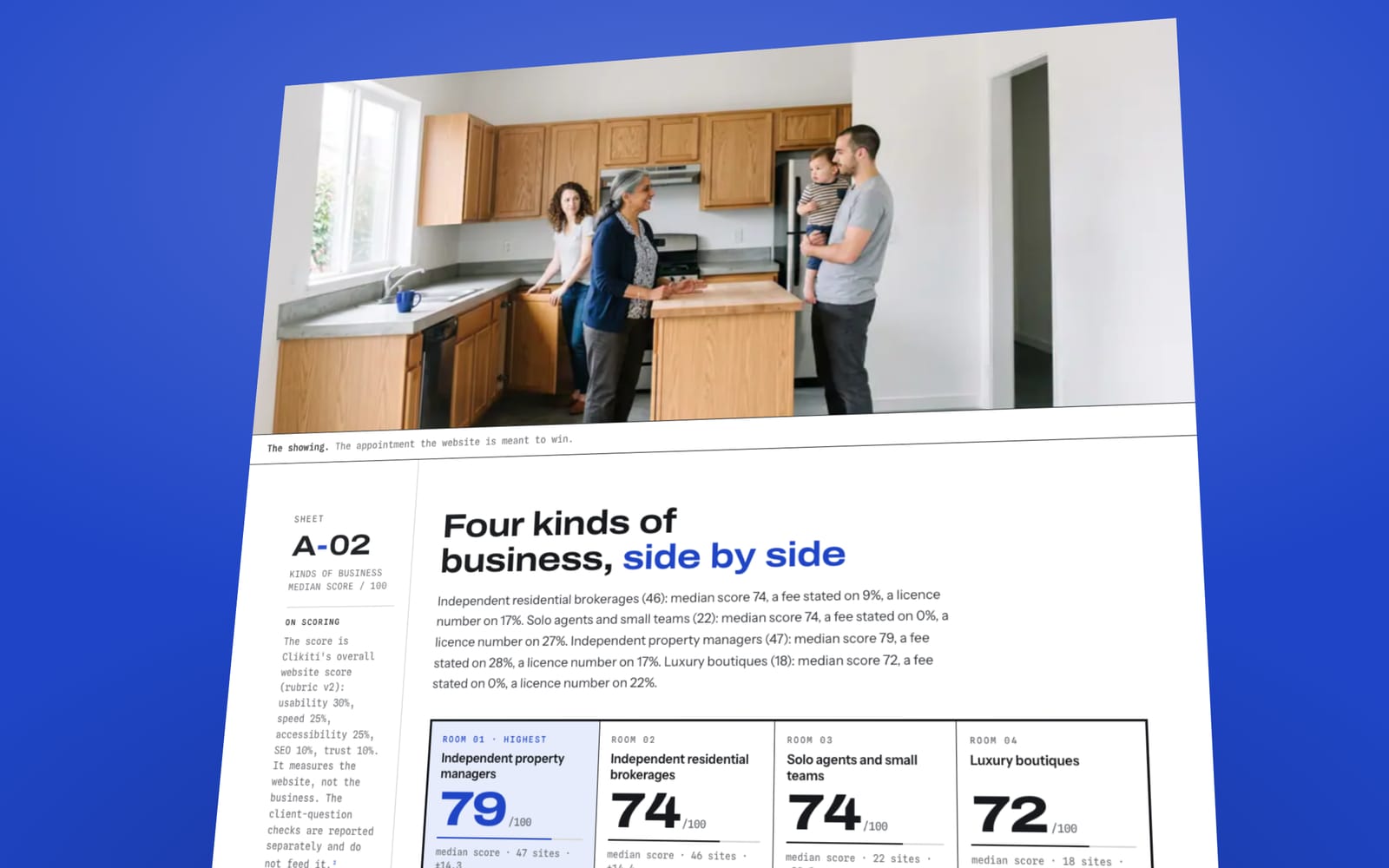
- Among solo agents and small teams, 27% show a licence number, 32% a sales record, 27% client reviews and none a commission.
- One agent page, linked from the home page, can answer all four. It is a content job of a few days, most of it spent collecting the agent's own record and reviews.
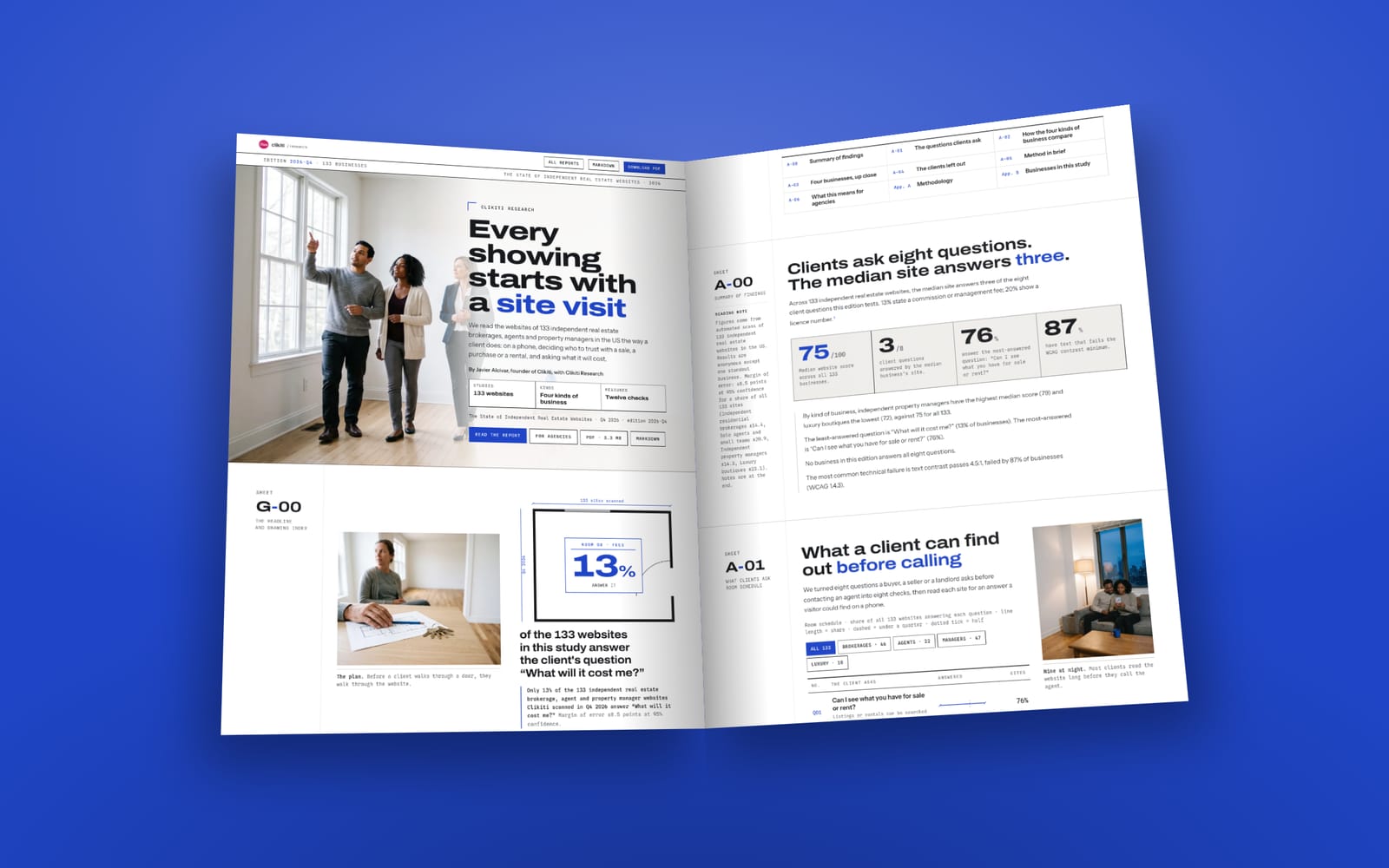
An agent page has one job: to get a seller or a buyer from "who is this?" to a phone call.
The State of Independent Real Estate Websites 2026 scanned 133 independent brokerages, solo agents and teams, property managers and luxury boutiques against eight client questions. 80% show no licence number. Among the 22 solo agent and small team sites, 27% show one, 32% show a sales record, 27% show client reviews, and none states a commission.
of the 133 websites we scanned answer “Are you licensed?” (a real estate licence number is shown).
This playbook is the page itself, drawn the way an architect issues a sheet: a schedule of marks, each with a position, a size on a phone and the question it answers. It is written for a solo agent or a small team. For a brokerage, the same marks go on each agent's profile, and the licence and record lines also go on the team page.
The schedule#
Sizes are for a phone about 390 px wide; "first screen" is what shows before scrolling.
| Mark | Element | Position | Size on a phone | Answers | Agent and team sites that pass |
|---|---|---|---|---|---|
| A1 | Name, photo, licence line | First screen, top | Photo 96 px square, name at heading size, licence in body text | Are you licensed? | 27% |
| A2 | Call and message | First screen, under A1 | Two buttons, full width, 48 px tall | How do I reach you? | 55% |
| A3 | Where I work | Second screen | One line per town, each a link | Do you work where I live? | 18% |
| A4 | Record | Second screen, beside A3 on desktop | Three figures, then a list of recent sales | Have you sold homes like mine? | 32% |
| A5 | Reviews | Third screen | Three reviews, each 60 words or fewer | Do past clients vouch for you? | 27% |
| A6 | How I'm paid | Third screen, after A5 | One short paragraph | What will it cost me? | 0% |
| A7 | Home value request | Last screen | One form, four fields | What's my home worth? | 55% |
The last column is the share of the 22 solo agent and team sites in the study that answer that question anywhere the scan reads. The two least answered are A6 and A3, and both are words on a page, not a build.
A1: the licence line#
Position: directly under the agent's name, in the first screen. Repeat it in the footer of every page.
Rule it meets: a real estate licence number on the home, about, agents or contact page. An MLS member number or a mortgage NMLS number doesn't count. The scan reads the page the home page links to as "About", "Agents" or "Our team", so for a solo agent the agent page should be the About page.
Write the licence type, the state and the number exactly as the state commission issued it, and name the brokerage the agent works under.
Licensed real estate salesperson in Ohio, working under the brokerage named in the footer of this page. You can check my licence on the Ohio Division of Real Estate and Professional Licensing's public lookup.
The agent's own number goes straight after the first line, in the same type size. It is the shortest job on the sheet and the most often missing.
A2: call and message#
Position: two buttons under A1, before any photo gallery. Size: full width, at least 48 px tall, so a thumb can't miss them.
Rule it meets: a tappable phone link on the home page plus a contact form or a showing request. 60% of all 133 sites pass; 55% of agent and team sites do.
A3: where I work#
Position: second screen. Size: one line per town or neighbourhood, each linking to a page about it.
Rule it meets: links to community pages, or three or more towns named. Only 18% of agent and team sites pass, the lowest of any segment; luxury boutiques reach 67%.
Where I work. I list and sell homes in Worthington, Clintonville, Dublin and Westerville, and I help buyers across Central Ohio. Each town below has a page with the streets I know best and what has sold there this year.
A4: the record#
Position: second screen, beside A3 on a desktop, under it on a phone. Size: three figures in large type (homes sold, years in the business, a sales volume or a count of families helped), then a short list of recent sales.
Rule it meets: a count of homes sold or closed, a sales volume, or a sold page. 26% of all sites pass. Luxury boutiques lead at 67%.
Use the agent's own figures from the MLS, and put a "since" year beside them so the numbers stay true.
Recent sales. Every home I've helped sell or buy in the last twelve months, with the street, the month it closed and whether I represented the buyer or the seller.
A5: reviews#
Position: third screen. Size: three reviews, each 60 words or fewer, with the client's first name and the town.
Rule it meets: review markup, a review widget, or at least two quoted testimonials on a page that presents them as client reviews. A quote from the agent's own bio doesn't count. 40% of all sites pass and 27% of agent and team sites do.
A6: how I'm paid#
Position: third screen, after the reviews, where the client has decided they like the agent and asks the next question. Size: one paragraph.
Rule it meets: a commission or fee stated as a percentage or a dollar amount, on the home, about, fees or valuation page. 13% of all sites pass, most of them property managers. Not one solo agent, team or luxury site in the study does.
How I'm paid. When you sell with me, my commission is a percentage of the sale price, agreed in writing before your home is listed. When you buy with me, we sign a buyer agreement before we tour homes, and it states what I'm paid and who pays it. Ask me on our first call and I'll walk you through both.
That paragraph is finished text, and it still doesn't pass on its own: the rule needs a figure. Add the agent's usual rate or a starting point ("from") in the first sentence. That decision is the agent's, and it takes longer than the build.
A7: home value request#
Position: last screen. Size: one form with four fields: address, name, email, phone.
Rule it meets: a home valuation or market analysis offered. 58% of all sites pass.
What does it take to build?#
Ask the agent for four things in one email: the licence number as issued, the towns they work, their closed sales for the last year from the MLS, and three client reviews they're happy to publish. With those, the page is two or three days of writing and layout on the existing site. Link it from the home page menu as "About" for a solo agent, or "Our team" for a brokerage, because that is the link both clients and the scan follow.
How do you pitch it?
- Open on the licence. "80% of independent real estate sites don't show a licence number, and yours is one of them." It is a fact the agent can check in ten seconds.
- Show the schedule, not a mockup. Seven marks, each with the question it answers. The agent sees the gaps on their own site without you designing anything.
- Leave A6 to them. Bring the paragraph, and let the agent decide whether to publish a rate. It is the one mark where saying no costs them, and they should know that.
A careful client checks the licence first, and your site makes them look it up elsewhere.
The comparison with law firms, who sell the same kind of trust, is in our cross-industry look at real estate and law. For another page built section by section, see the dental insurance build sheet.
Keep reading
More on real estate and the same problems in other industries


How to cite
Clikiti Research (2026, October 15). The agent page, measured: a spec for the 80% of sites with no licence number. Clikiti. https://clikiti.com/research/posts/realestate-agent-page-spec
Data and license
Every number comes from The State of Independent Real Estate Websites 2026 (n = 133). Free to reuse under CC BY 4.0. Credit Clikiti with a link. Plain Markdown
About the images
People in the photographs on this page are AI-generated. No real person, school, firm or practice is shown. Last updated Oct 15, 2026.
One stat. One pitch. Every Tuesday.
A finding from our scans, what it means for the agencies selling to that industry, and the line to open a pitch with. Free.