
Method note: how we judged referral, insurance and price on 148 clinic sites
Only 18% of 148 independent physical therapy and chiropractic sites show a self-pay price. This note sets out the rules behind that number and the two next to it, with the wording that passed and the wording that did not.
- Only 18% of 148 independent physical therapy and chiropractic clinic websites show a self-pay price for a visit or session (Clikiti Research, October 2026).
- 27% say a patient can come in without a doctor's referral, and 39% name an insurance plan or say the clinic is out of network. All three are counted by fixed published rules, read from the clinic's own pages.
- The rules are strict on purpose: "most major insurance accepted" and "$99 value" do not count. An agency can run the same tests on a prospect's site in a few minutes.

This is a note on method. It explains how The State of Independent Physical Therapy Websites 2026 decided three of its hardest questions: does the site say a patient can come in without a referral, does it say which insurance the clinic takes, and does it show what a visit costs to a patient paying for it themselves.
The study read 148 independent clinic sites: outpatient physical therapy, chiropractic, sports and orthopedic rehab, and massage, wellness and pelvic-health specialists. The headline is the price question. Only 18% of the sites show a self-pay price for a visit or session.
of the 148 websites we scanned answer “What if I pay myself?” (a self-pay price shown for a visit or session).
All three questions sit at the bottom of the table. Referral is answered by 27% of sites, insurance by 39%. The other six questions do better, up to 84% for naming the conditions a clinic treats.
Share of sites that answer each question
148 websites · Independent physical therapy and chiropractic clinics · Q4 2026
What the rules read#
Each site was read as a server delivers it: the home page, then the best-matching link on the home page for each of eight topics (conditions, new patients, insurance and rates, team, about, reviews, booking, contact). That is at most nine pages per clinic. A rule passes a site when the words are on one of those pages. Each rule records the sentence that made it pass, so every result can be checked by a person.
Three limits follow from this, and they apply to every number below.
- A page the home page does not link to is not read. An insurance list two clicks deep is not seen.
- A price list posted as an image or a PDF is not read.
- A few sites build their text in the visitor's browser, so the served page carries little of it. The study reads what the server sends, as it did for every other industry.
So a fail means a patient following the obvious links would not find the answer in text. It does not mean the clinic has no answer.
Referral: what had to be said#
The rule passes a site that says, in words, that a patient can be seen without a doctor's referral or prescription. Wording that passed:
- "No referral needed", "No referral required", "No prescription needed".
- A question and its answer: "Do I need a referral?" followed by "No."
- A sentence naming the state's law, such as a state being "a direct access state" for physical therapy, followed by what that means for the patient.
Wording that failed:
- "Direct access" used about something else, such as direct access to your therapist by text. The phrase counts only when referrals, doctors, prescriptions or the law are mentioned next to it.
- "Do I need a referral? It depends on your insurance," with no statement that the clinic itself needs none.
- A page that never raises referrals at all. That is a fail too: 73% of sites do not answer the question on the pages read.
The study does not judge whether a statement is correct for the clinic's state or for a given plan. It records whether the site gives the patient an answer.
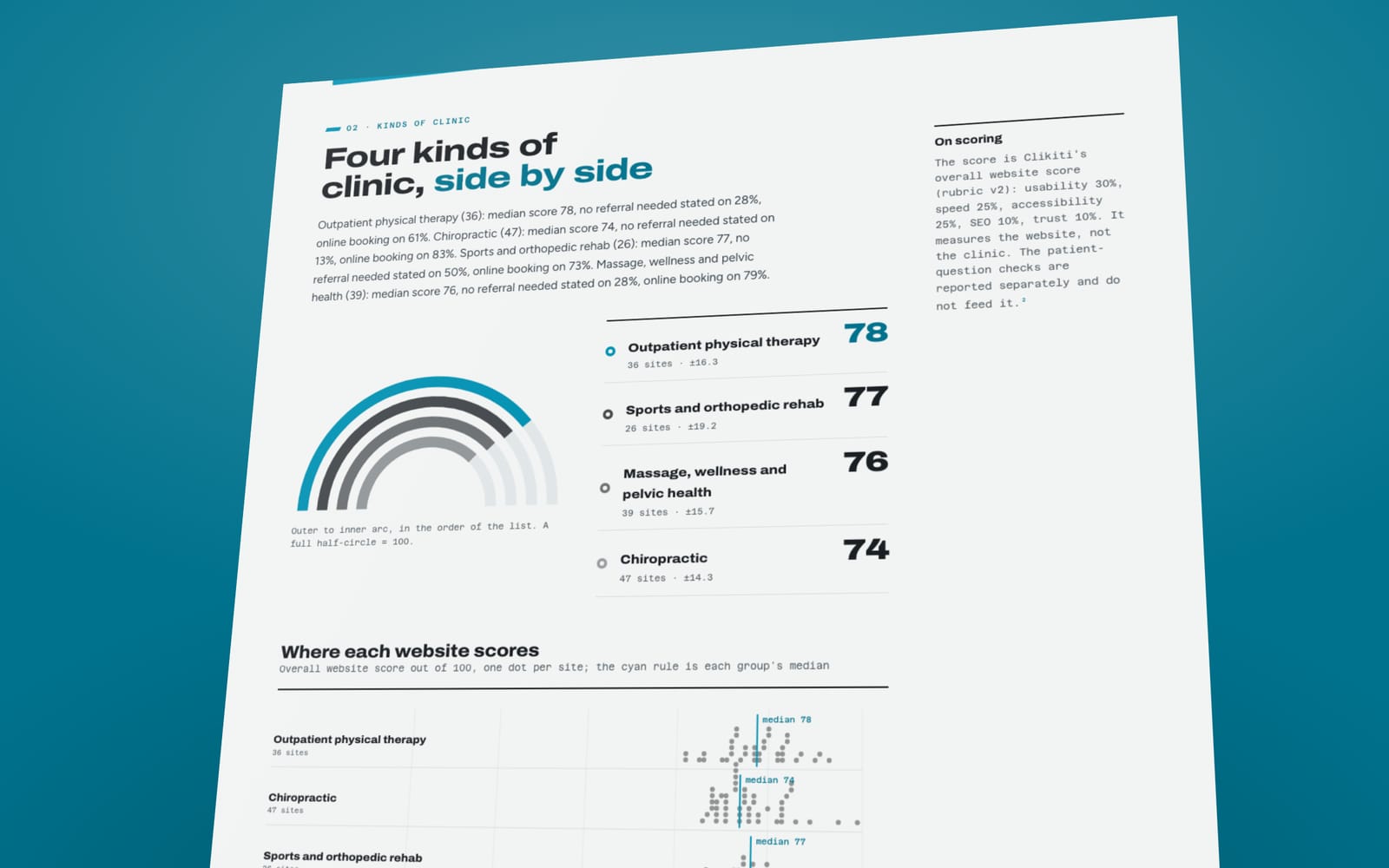
The split by kind of clinic is wide. 50% of sports and orthopedic rehab sites say no referral is needed, against 13% of chiropractic sites. The data does not say why. It does say what a patient sees: on most chiropractic sites, the question is left for the phone call. A rule cannot tell an answer left out because it seemed obvious from one left out by oversight, and neither can the patient.
Insurance: one plan was enough, "most plans" was not#
The rule passes a site that names at least one plan or payer (Medicare, Blue Cross, Aetna, a regional plan), or says the clinic is out of network, does not take insurance, or runs as a cash-based practice. An out-of-network statement answers the patient's question as well as a list does.
A site that names only Medicare passes. That is a low bar, and it was set low deliberately: one named plan tells some patients something definite.
What failed was the most common wording of all: "We accept most major insurance plans," or "Insurance accepted," with no plan named. A patient with a particular card cannot tell from that sentence whether their plan is one of them. They still have to call. 61% of sites leave the question there or say nothing.
Chiropractic sites name a plan or a payment model most often, at 49%. Massage, wellness and pelvic-health sites do so least, at 28%.
Self-pay price: the rule with the most exceptions#
The rule passes a dollar amount that sits next to a visit, a session, an evaluation, a treatment length or a package. Wording that passed:
- A visit price: new patient appointments at one amount, follow-ups at another.
- A massage or bodywork menu: minutes and a price on each line.
- A package: a number of sessions and its price.
- An introductory exam at a stated price. A new-patient special is still the price of a visit, so it counts.
Wording that failed, each added after reading the evidence from an earlier run of the rule:
- An amount followed by "value", or after "save" or "off". A discount is not a price.
- A copay, a coinsurance figure, or a deposit "applied toward your deductible". These are amounts an insured patient pays, not the clinic's self-pay rate.
- Cancellation, no-show and late fees.
- Market ranges, such as what physical therapy sessions "typically cost". That describes the market, not the clinic.
- Gift cards.
After those exceptions, 82% of sites show no self-pay price. The gap between kinds of clinic is the widest in the study: 41% of massage, wellness and pelvic-health sites show one, against 13% of chiropractic, 8% of outpatient physical therapy and 4% of sports and orthopedic rehab sites. The passing specialty sites are of two kinds: massage studios with a menu of session lengths and prices, and pelvic-health or out-of-network therapy practices that list an evaluation and a follow-up visit, each with its price, on a rates or booking page.
How the rules were checked#
Each rule was run over the whole cohort, then a reviewer read the recorded evidence for a sample of passes and fails in every group of clinics. False passes were fixed by narrowing the rule, and the run was repeated, until the sample read clean. The rules and their version are published with the report, in Appendix A4 of the full edition.
The margin of error on any share across all 148 sites is 8.1 points at 95% confidence. It is wider for each kind of clinic, because each group is smaller.
What it means for an agency#
The rules are written so that anyone can apply them by hand. That is their use to you. On a prospect's site, open the home page on a phone and follow only the links in the menu. Then ask three things.
- Does any page say, in a sentence, that a patient can come in without a referral?
- Is at least one insurance plan named, or does the site say the clinic is out of network?
- Is there a dollar amount next to a visit, a session or a package that is not a discount, a copay or a fee for missing an appointment?
Each "no" is a small, specific job: one line on the home page, one insurance page, one rate card. None needs a redesign. The report rates the referral line a quick fix, and the price a content job, because the clinic has to agree the numbers.
Do I need a referral? No. You can book an evaluation with us directly, without seeing a doctor first. If your insurance plan asks for a referral before it will pay, we will tell you when you book.
Write that line only once the clinic has confirmed it is true for its state and its main plans.
For the conversation that gets those answers out of the owner, see ten questions for the first call with a clinic owner. For the same insurance question in another industry, see what dental practice websites say about insurance.
Keep reading
More on physical therapy and the same problems in other industries

Ten questions for the first call with a physical therapy clinic owner

72% of salon websites take bookings online. 42% say what happens if you cancel.

The inquiry email couples write because 91% of venue sites don't show open dates
How to cite
Clikiti Research (2026, October 15). Method note: how we judged referral, insurance and price on 148 clinic sites. Clikiti. https://clikiti.com/research/posts/physio-study-how-we-judged-referral-and-price
Data and license
Every number comes from The State of Independent Physical Therapy Websites 2026 (n = 148). Free to reuse under CC BY 4.0. Credit Clikiti with a link. Plain Markdown
About the images
People in the photographs on this page are AI-generated. No real person, school, firm or practice is shown. Last updated Oct 15, 2026.
One stat. One pitch. Every Tuesday.
A finding from our scans, what it means for the agencies selling to that industry, and the line to open a pitch with. Free.