
Personal, commercial, Medicare: three kinds of insurance agency, three websites
We scanned 170 independent insurance agency websites. Personal lines, commercial and life, health and Medicare agencies score within three points of each other, then split hard on claims, client service and naming the companies they quote.
- Only 39% of 170 independent insurance agency websites say how to file a claim with a number or a link (Clikiti Research, October 2026).
- By kind of agency the split is wide: 56% of personal lines sites explain claims, against 40% of commercial sites and 10% of life, health and Medicare sites. Online service runs 63%, 74% and 12%.
- The overall scores sit at 78, 78 and 75. What separates the three is what each kind of agency is asked for after the sale, and that is where an agency's pitch should start.
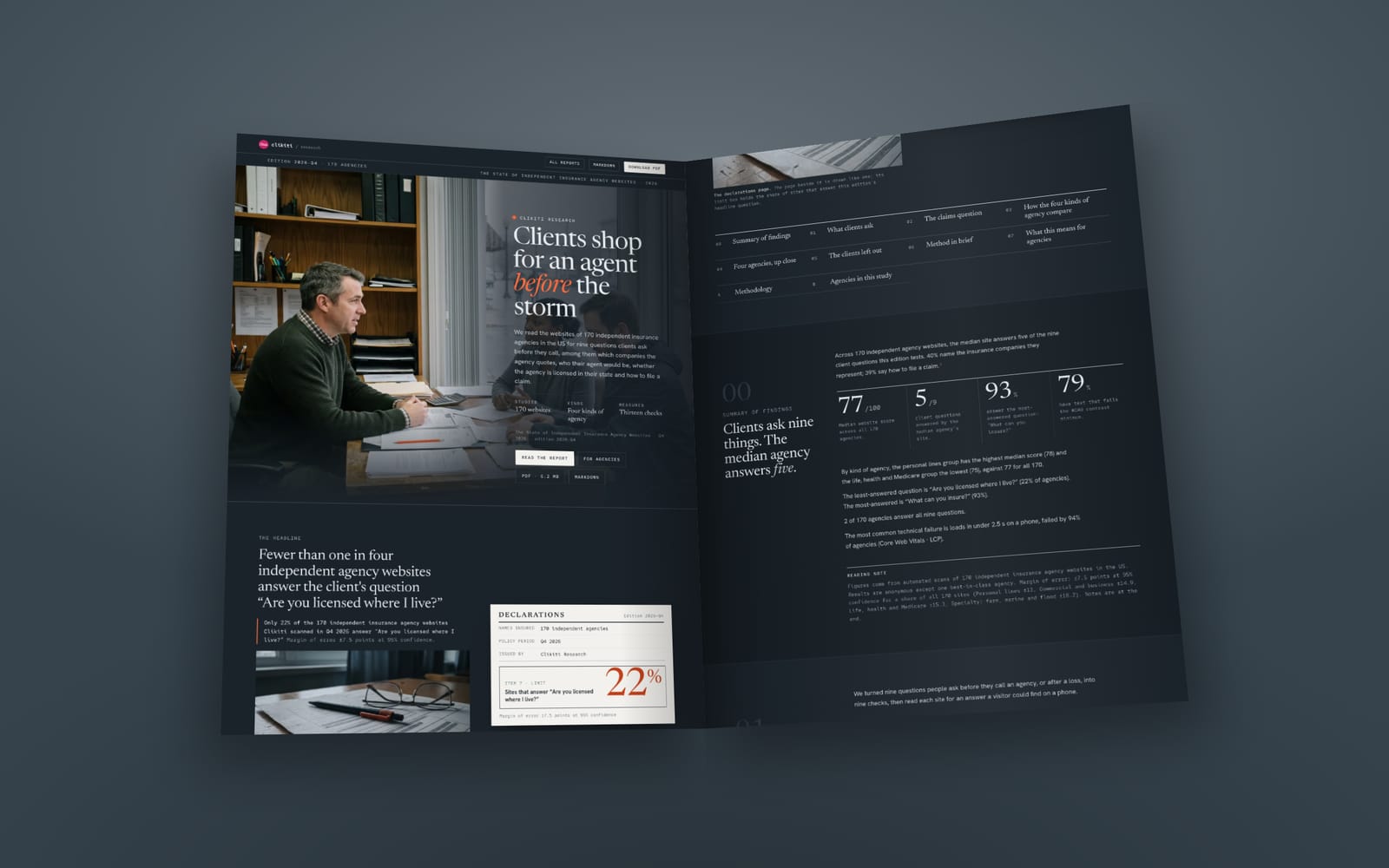
"Independent insurance agency" covers three different businesses. One sells home and car insurance to households. One places cover for businesses and keeps their certificates in order. One sells life cover, health plans and Medicare to individuals, often people turning 65. In The State of Independent Insurance Agency Websites 2026 we read 170 of their websites against nine questions clients ask, and the three groups look alike until you ask what happens after the sale.
The headline for claims: only 39% of the 170 sites say how to file a claim, with a phone number or a link to do it. That share hides a spread from more than half to one in ten.
of the 170 websites we scanned answer “What do I do when I need to claim?” (how to file a claim, with a number or link).
How alike do they look?#
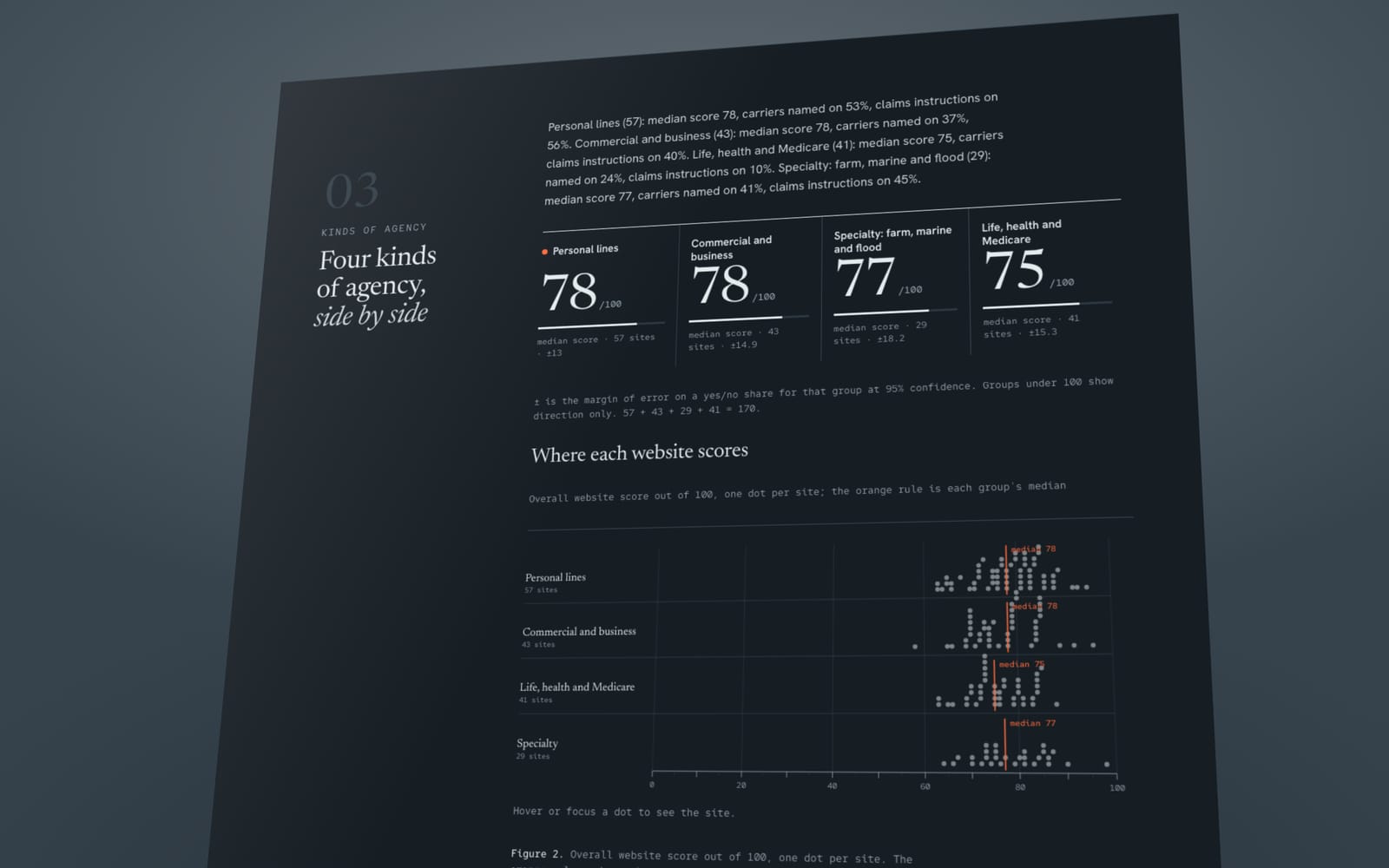
On the overall score, very alike. The score covers speed, accessibility, usability, search and trust; the client questions are reported apart from it.
| Kind of agency | Sites | Median score |
|---|---|---|
| Personal lines | 57 | 78 |
| Commercial and business | 43 | 78 |
| Life, health and Medicare | 41 | 75 |
A fourth group, 29 specialty agencies writing farm, marine and flood cover, is in the report and left out here to keep the comparison to three. On the score alone, an agency owner would treat these as one market. The questions say otherwise.
Where do they split?#
The share of sites in each group that answers the question:
| The client asks | Personal | Commercial | Life, health, Medicare |
|---|---|---|---|
| What do I do when I need to claim? | 56% | 40% | 10% |
| Can I pay or change my policy without calling? | 63% | 74% | 12% |
| Which companies do you quote? | 53% | 37% | 24% |
| Can I start a quote online? | 84% | 86% | 59% |
| Are you licensed where I live? | 21% | 26% | 27% |
The last row is there for contrast. Licence details are the least-answered question in the study, at 22% overall, and no kind of agency is much better at it than another. The four rows above it are where the trade decides what the website says.
What passes: a claims instruction with a phone number or a link beside it, or a carriers page listing each company's claims number; a bill-pay, ID card, certificate or policy change link; three or more insurance companies named in text, not only as logos; and a link, button or form that starts a quote.
Personal lines: the household's whole file#
A personal lines agency sells home, auto, umbrella and renters cover, usually as a bundle, usually from several companies. Its pitch to a household is choice: we compare the companies so you don't have to. It follows that these sites name their carriers more than anyone else, and still only 53% do. The other 47% make the independent agency's main argument without the evidence for it.
Home and car policies are the ones a household is most likely to claim on, and the sites go furthest here: 56% explain how to file a claim, the best of the three. That still leaves 44% where a policyholder looking for the claims number finds the agency's phone and a contact form, or nothing.
Commercial: the account is the product#
A commercial agency's client is a business that needs certificates of insurance for contracts, adds vehicles and drivers, changes payroll figures and renews every year. The work after the sale is constant and administrative, and the websites show it: 74% of commercial sites offer online bill pay, certificates or policy change requests, the highest of any group.
Claims are another matter. 40% of commercial sites say how to file one. A business claim often runs through an account manager rather than a phone line, which may be why. The scan reads what the site says, not why, and from the site a business owner can't tell whom to call. Carriers are named on 37% of commercial sites, lower than personal lines. Commercial agencies often place cover with specialist markets that a client wouldn't recognise, so the list may feel less useful to them. To a prospect it still answers a plain question.
Life, health and Medicare: sold once, then quiet#
This group sells a policy or a plan and then, for most clients, hears little until the next enrolment period. The client's ongoing dealings, from claims to bills to ID cards, are with the insurer or the health plan rather than the agency. The websites match that: 10% explain claims and 12% offer any online service. Quoting online is lower too, at 59%, against 84% and 86% for the other two.
Some of that is the trade working as designed. A Medicare broker doesn't process claims, and a site that pretends to would be wrong. But a client with a plan problem may still look on the broker's site first, and on nine sites in ten there is no line saying who to call. Carriers fare no better: 24% of these sites name three or more of the plans or companies they work with, although the plan names are exactly what a client is comparing.
What changes before a call#
Name the kind of agency first, then open the site at the question its trade owes a client:
- Personal lines: the carriers page, then the claims page. The pitch is the agency's own argument: you compare the companies, so name them.
- Commercial: the claims instructions. The service portal is usually there already; the claims path usually isn't.
- Life, health and Medicare: one plain page on what to do when a plan problem comes up, with the plans' member service lines and the agency's own number. Claims processing stays with the plan; the page only says who handles what.
For all three, the licence line is the cheapest fix in the study: 78% of sites don't show a licence number, an NPN or the states the agency is licensed in, and the agency already has the numbers.
Dental practices face the same question from the other side of the desk, in what dental websites say about insurance. The full numbers, the method and the fourth group of specialty agencies are in the insurance report.
Keep reading
More on insurance and the same problems in other industries

The referral partner pitch: reaching an insurance agency through a client you already have

Four kinds of gym, four different gaps: a scouting report on 165 gym websites

Line by line: ten patient questions on optometry websites, from 86% down to 7%
How to cite
Clikiti Research (2026, October 15). Personal, commercial, Medicare: three kinds of insurance agency, three websites. Clikiti. https://clikiti.com/research/posts/insurance-agency-websites-three-kinds
Data and license
Every number comes from The State of Independent Insurance Agency Websites 2026 (n = 170). Free to reuse under CC BY 4.0. Credit Clikiti with a link. Plain Markdown
About the images
People in the photographs on this page are AI-generated. No real person, school, firm or practice is shown. Last updated Oct 15, 2026.
One stat. One pitch. Every Tuesday.
A finding from our scans, what it means for the agencies selling to that industry, and the line to open a pitch with. Free.