
The one-page scope: what to send a small accounting firm after the first call
87% of 158 accounting practice websites show no price and 85% offer no way to book a first call online. This is the one-page proposal that turns those gaps into scope lines a small firm can approve: what each line covers, what is included and how long it takes.
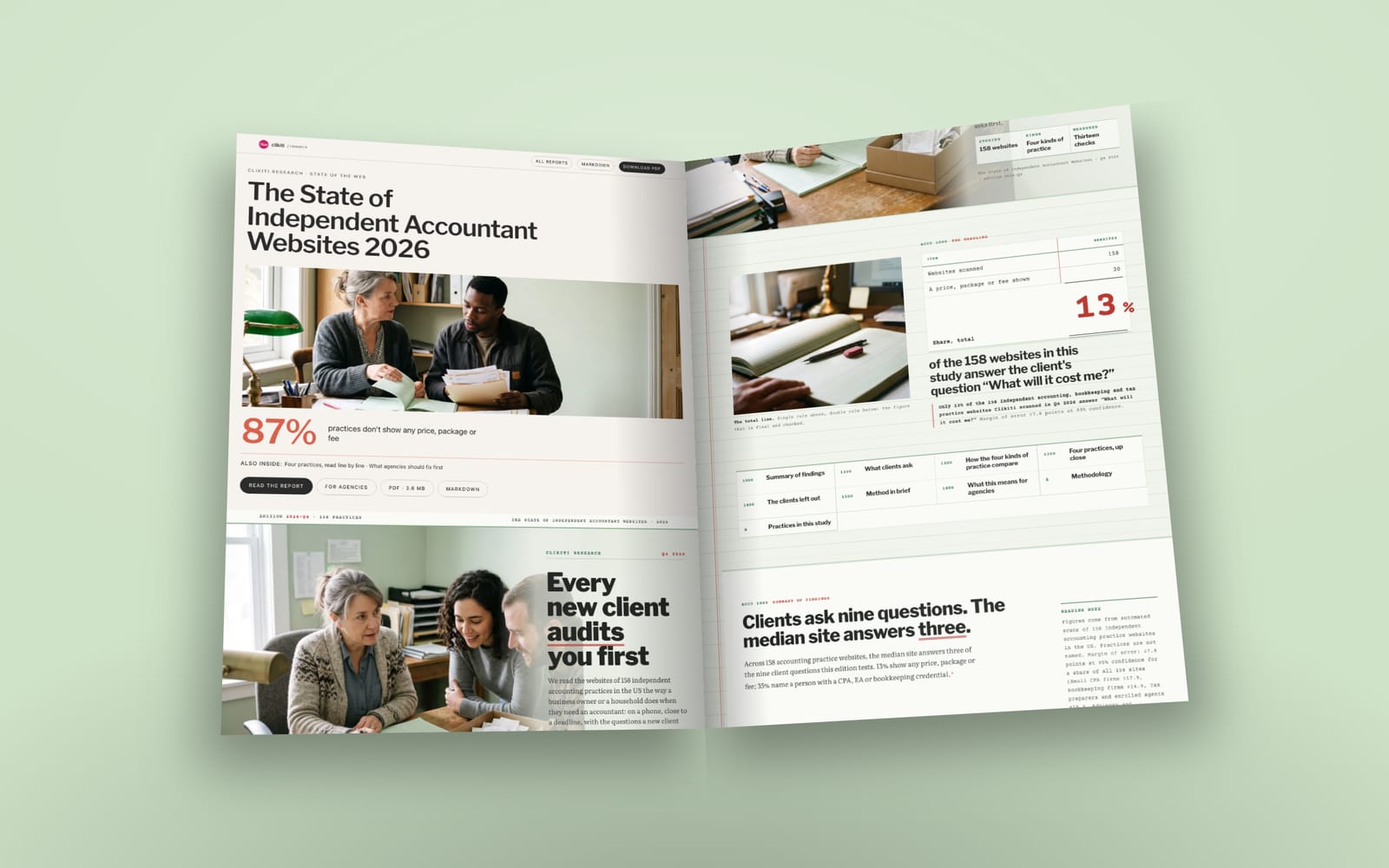
- 87% of 158 independent accounting, bookkeeping, tax and advisory practice websites show no price, package or fee (Clikiti Research, October 2026).
- 77% link no working client portal and 85% offer no way to book a first consultation online; each is a scope line with a fixed deliverable.
- Build the scope only from the questions the firm's own site fails, ordered quick fixes first, so the firm sees changes in the first week.
A small accounting firm reads a proposal the way it reads a client's books: line by line, looking for the item that doesn't belong. So the document an agency sends after a first call should be short, itemised and built on that firm's own website, not a rate card. This is the one-page scope, with the text for each line ready to adapt.
Every line comes from The State of Independent Accountant Websites 2026, our read of 158 small CPA, bookkeeping, tax and advisory practice websites against nine questions a new client asks. 87% of the sites show no price, package or fee, and that is only the first line.
of the 158 websites we scanned answer “What will it cost me?” (a price, package or fee shown).
What goes on the page?#
Three blocks, and nothing else: the scope lines, what is included, and the timeline. Price each line separately so the firm can strike one without reopening the whole proposal. Partners who sign engagement letters for a living prefer to approve items, not packages.
The scope lines are the questions the firm's site fails. Before you write anything, open the site on a phone and check it against the report's nine rules. A line goes in only if the site fails that check. A firm that already shows a fees page doesn't get a fees line, however common the gap is elsewhere.
Which lines will most firms need?#
Here are the eight lines that come up most, in the order to deliver them, with the share of sites in the study that miss each one.
1. Contact (quick fix). 54% of the sites don't pair a tappable phone number with a street address.
Contact details. Make the phone number tappable in the header on every page, and add the office's street address with ZIP code to every page footer, so a client on a phone can call or find the office in one tap.
2. Client portal (quick fix). 77% of the sites link no working secure portal. Bookkeeping and advisory firms are at 93% each.
Secure documents. Link the practice's existing client portal from the header as "Send documents securely", test that it opens the practice's own sign-in, and remove any template portal links that lead elsewhere.
3. Structured data (quick fix). 82% of the sites carry no AccountingService markup.
Search markup. Add AccountingService structured data with the practice's name, address, phone number, opening hours and services, and validate it with Google's Rich Results test.
4. Reviews (quick fix). 69% of the sites show, quote or mark up no client review. Small CPA firms are at 93%.
Client reviews. Show a selection of the practice's existing public reviews on the home page and the services pages, with Review markup, linking to the full set where clients left them.
5. Credentials and team (content). 65% of the sites name no CPA, EA or certified bookkeeper, and 68% name nobody with a short bio. Bookkeeping firms miss credentials on 81%.
Who does the work. A team page with a photograph, the credential and a three-sentence bio for each person who does client work, and the lead credential named on the home page. The practice supplies the facts; we write and lay out the page.
6. Fees (content). 87% of the sites show no price, package or fee. Small CPA firms are at 97%.
Fees. One page with starting prices for the practice's three most common engagements, for example an individual return, a business return and monthly bookkeeping, linked from the home page and the services menu. The practice sets the figures; we write the page around them and add a line on what changes the price.
Where the figure belongs to the firm, the scope says so. Never put your own guess at their fees in a proposal.
7. First-call booking (build). 85% of the sites offer no way to book a first consultation online.
Book a first call. Embed an online scheduler for a 20-minute first consultation on the contact page and link it from the home page, connected to the calendar of the person who takes new-client calls.
8. Phone speed (build). 95% of the sites don't load their main content in under 2.5 seconds on a phone.
Speed. Resize and compress the home page images, defer non-essential scripts and retest until the home page loads its main content in under 2.5 seconds on a mid-range phone, with a before-and-after report.
What is included, and what isn't?#
Say it once, plainly, under the lines. It saves the conversation in week three.
Included: the changes listed above on the practice's current website and platform, writing for every new page, one round of revisions per page, and a before-and-after check of each item against the same rules used to find it. Not included: a redesign, new photography, changes to the portal or scheduling software itself, and the practice's own figures, credentials and review permissions, which the practice provides.
How long does it take?#
Order the timeline by the report's effort ratings: quick fixes first, so the firm sees the site change in the first week, then content, then builds. Content waits on the firm, so the timeline says what the firm owes and when.
Week 1: contact details, portal link, search markup and reviews go live. By the end of week 1, the practice sends its fee figures, team credentials and bios. Week 2: team page and fees page drafted for review. Week 3: revisions, scheduler set up, speed work. Week 4: final check against every line, and the before-and-after report.
For a tax practice, don't start this in March. A firm in filing season will not send fee figures in week one, and a fees page that launches in April has missed its readers.
Which firm gets which version?#
The lines change by kind of practice, because the gaps do.
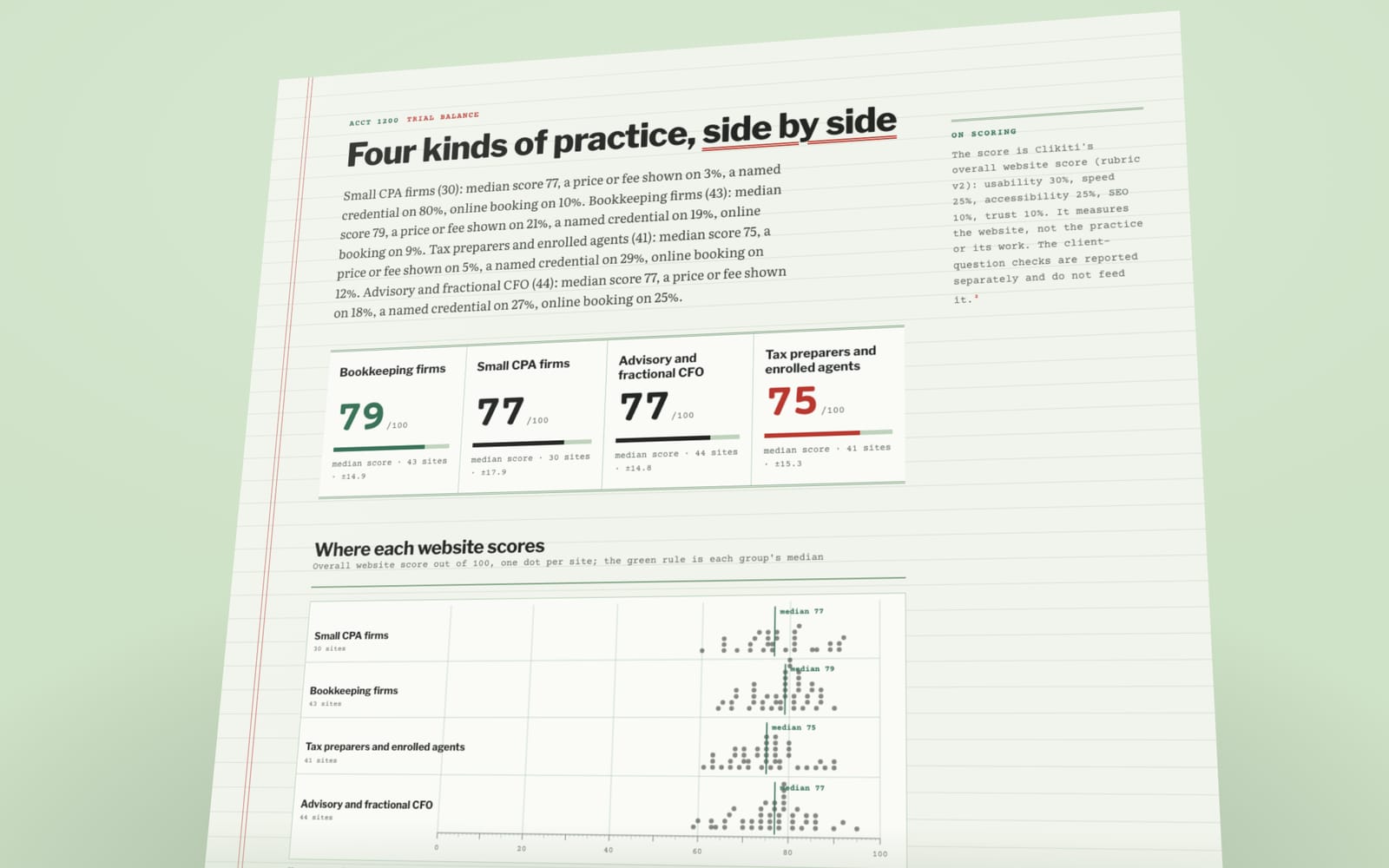
- Small CPA firms mostly name their credentials already (80% do) and link a portal more often than not. Their scope leads with fees and reviews, the two lines they miss on 97% and 93% of sites.
- Bookkeeping firms are the reverse: reviews are common, credentials are missing on 81% and a portal on 93%. Their scope leads with the team page and the portal link, and adds contact, which they miss on 72% of sites.
- Advisory and fractional CFO firms book online more than anyone, at 25%, and still miss the portal on 93%. Their scope is often three quick fixes and a fees page.
Sending the scope
- Scope from their site, not your rate card. Check the nine questions on a phone and write a line only for each one the firm fails.
- Lead with the line that costs them clients. For most firms it is fees: 87% of the 158 sites show none.
- Put the firm's homework in the timeline. Fee figures, credentials and bios by the end of week one, or the content lines move.
Your clients email you their tax documents because your site gives them no safe way to send them.
The eight gaps behind these lines are set out one number at a time in eight numbers from 158 practices. For a scope written section by section for one page, see the dental insurance page build sheet. The full method is in the report.
Keep reading
More on accounting and the same problems in other industries



How to cite
Clikiti Research (2026, October 15). The one-page scope: what to send a small accounting firm after the first call. Clikiti. https://clikiti.com/research/posts/accounting-firm-website-one-page-scope
Data and license
Every number comes from The State of Independent Accountant Websites 2026 (n = 158). Free to reuse under CC BY 4.0. Credit Clikiti with a link. Plain Markdown
About the images
People in the photographs on this page are AI-generated. No real person, school, firm or practice is shown. Last updated Oct 15, 2026.
One stat. One pitch. Every Tuesday.
A finding from our scans, what it means for the agencies selling to that industry, and the line to open a pitch with. Free.